

Oklahoma County (Central)–Oklahoma City, The Village & Nichols Hills Cities PUMA, Oklahoma · population, demographics and census data
Home to 114,496 people, the 27th largest of Oklahoma’s 31 PUMAs, anchored by The Village.
- Population
- 114,496 ±10,140. Rank 27 of 31 in Oklahoma
- Median household income
- $69,470 ±$6,225. Oklahoma $68,441 · US $84,780
- Median age
- 34.9 ±1.9. Oklahoma 37.8 · US 39.5
ACS 2025 1-year estimates, U.S. Census Bureau
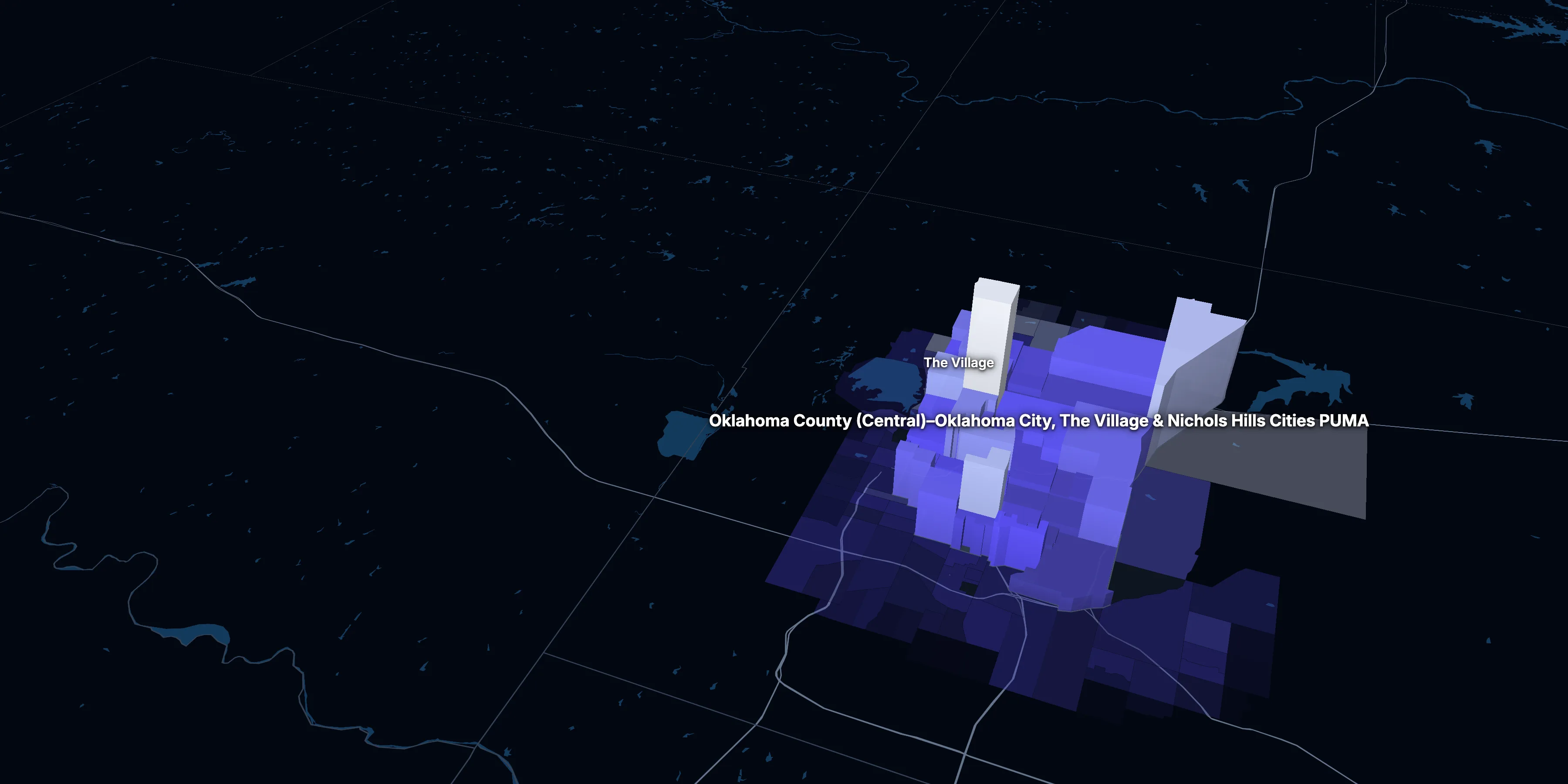
Taller, lighter tracts have higher household incomes
About Oklahoma County (Central)–Oklahoma City, The Village & Nichols Hills Cities PUMA
Oklahoma County (Central)–Oklahoma City, The Village & Nichols Hills Cities PUMA’s median household income is $69,470 (±$6,225), about the same as Oklahoma ($68,441) but lower than the US ($84,780), and its median age is 34.9 (±1.9), according to the ACS 2025 1-year estimates. Its largest city is The Village.
± is each figure’s margin of error, at 90% confidence, and † marks one too uncertain to lean on. Under each percentage in the tables is the number it counts. How the margins are worked out.
PUMA code 4021404
Highlights
What stands out in Oklahoma County (Central)–Oklahoma City, The Village & Nichols Hills Cities PUMA
The numbers where Oklahoma County (Central)–Oklahoma City, The Village & Nichols Hills Cities PUMA sits furthest from Oklahoma and the nation, or past a recognized policy benchmark.
Past a policy benchmark
42.5%
Very highHomes built before 1960
That’s higher than both Oklahoma (19.0%) and the US (24.0%). Older homes carry more lead-paint risk: the EPA found lead paint in 69% of homes built from 1940 to 1959. It’s the highest of 31 Oklahoma PUMAs.
Furthest from the national picture
19.0%
2nd lowest in OklahomaCommute 30 minutes or more
That’s lower than both Oklahoma (29.3%) and the US (39.2%). It’s the 2nd lowest of 31 Oklahoma PUMAs.
2.02
Lowest in OklahomaPeople per household
That’s lower than both Oklahoma (2.48) and the US (2.49). It’s the lowest of 31 Oklahoma PUMAs.
34.9
Lower than the USMedian age
That’s lower than both Oklahoma (37.8) and the US (39.5).
47.7%
3rd in OklahomaHouseholds that rent
That’s higher than both Oklahoma (34.5%) and the US (34.7%). It’s the 3rd highest of 31 Oklahoma PUMAs.
5.9%
Very lowBorn outside the US
That’s about the same as Oklahoma (6.4%) but lower than the US (14.7%).
Over time
How Oklahoma County (Central)–Oklahoma City, The Village & Nichols Hills Cities PUMA has changed
PUMAs were redrawn from the 2020 Census, so earlier figures under this code describe a different area. These are for the PUMA as drawn from 2020.
48 census tracts
Oklahoma County (Central)–Oklahoma City, The Village & Nichols Hills Cities PUMA, tract by tract
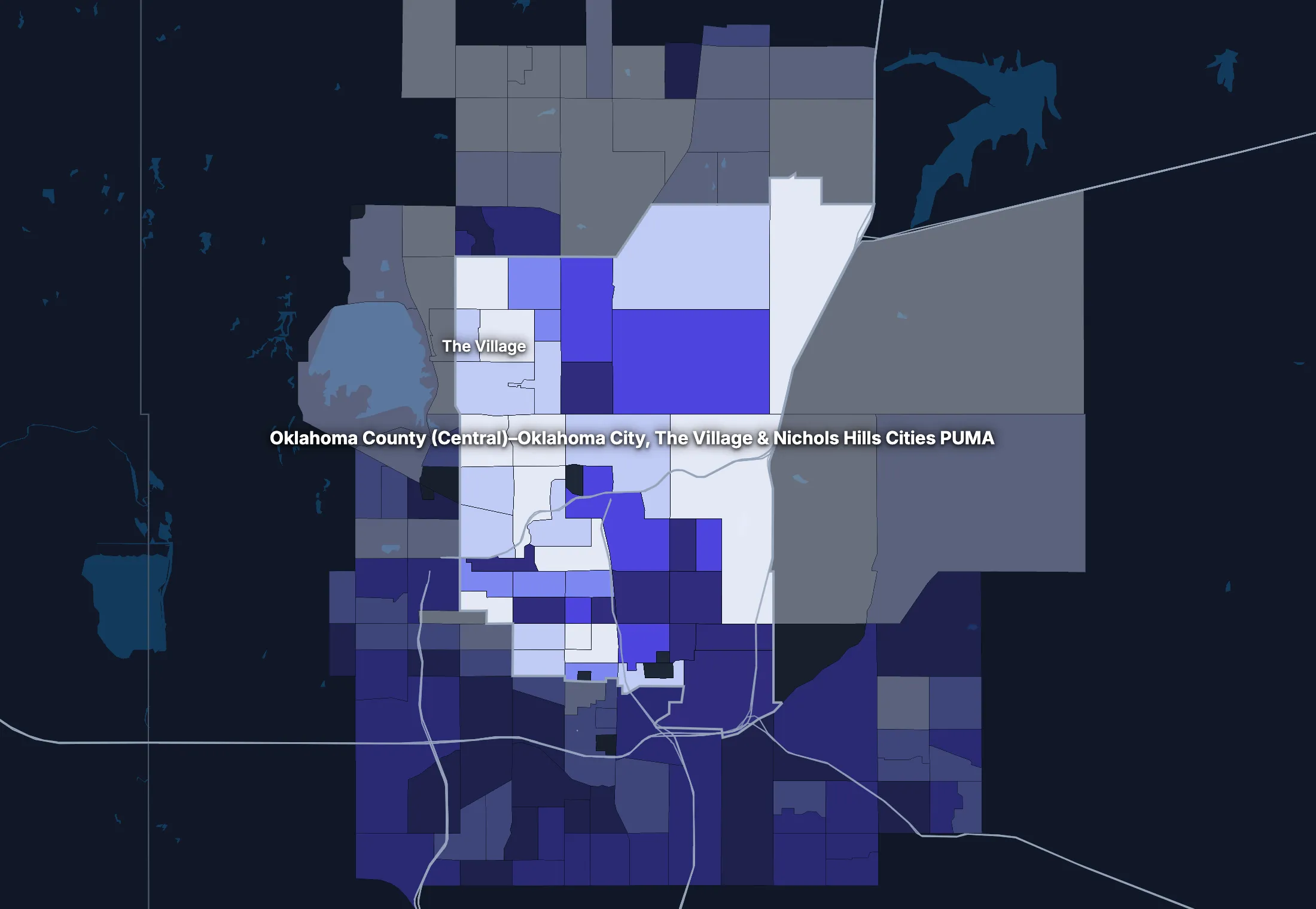
Area averages hide a lot. These census tracts are the closest the census comes to neighborhoods.
Where the area’s average misleads
Each tick is one census tract, and the dark line marks the area. Hover over a tick or tap it to see the tract.
Poverty
10 of 44 tracts are at least 1.5 times the area’s overall 17.3%, and 16 are at two-thirds of it or less.
Highest: Tract 1013, 49.1%. Lowest: Tract 1081.10, 3.3%.
Renters paying 30% or more of income
5 of 43 tracts are at least 1.5 times the area’s overall 44.5%, and 5 are at two-thirds of it or less.
Highest: Tract 1052.01, 81.2%. Lowest: Tract 1065.03, 18.8%.
Adults with a bachelor’s degree
7 of 44 tracts are at least 1.5 times the area’s overall 43.6%, and 14 are at two-thirds of it or less.
Highest: Tract 1096, 82.9%. Lowest: Tract 1052.02, 9.0%.
Median household income
6 of 44 tracts are at least 1.5 times the typical tract’s $63,262, and 10 are at two-thirds of it or less.
Highest: Tract 1064.01, $250,000 or more. Lowest: Tract 1095, $23,771.
American Community Survey 2020–2024 5-year estimates, by census tract. Income is capped at $250,000+ by the Census Bureau.
People
Who lives in Oklahoma County (Central)–Oklahoma City, The Village & Nichols Hills Cities PUMA
A younger area than Oklahoma (37.8) or the US (39.5), with a median age of 34.9. 5.9% of residents were born outside the US, and 13.2% speak a language other than English at home.
Age
Source: ACS 2025 1-year, table A01001.
Show data
| Oklahoma County (Central)–Oklahoma City, The Village & Nichols Hills Cities PUMA | Oklahoma | United States | |
|---|---|---|---|
| Under 18 | 19.4% ±2.6% , number 22,162 ±3,602 | 23.1% ±0.2% , number 954,217 ±9,887 | 21.0% ±<0.1% , number 71,689,151 ±111,800 |
| 18 to 24 | 9.0% ±1.9% , number 10,361 ±2,406 | 10.2% ±0.2% , number 418,950 ±8,694 | 9.3% ±<0.1% , number 31,716,680 ±98,660 |
| 25 to 34 | 21.8% ±1.9% , number 24,913 ±3,130 | 12.9% ±0.1% , number 531,460 ±4,408 | 13.6% ±<0.1% , number 46,357,354 ±55,690 |
| 35 to 44 | 17.1% ±2.1% , number 19,535 ±2,934 | 13.3% ±0.2% , number 547,357 ±8,822 | 13.4% ±<0.1% , number 45,746,189 ±105,700 |
| 45 to 54 | 8.4% ±1.4% , number 9,660 ±1,766 | 11.4% ±0.1% , number 468,459 ±4,748 | 11.8% ±<0.1% , number 40,257,563 ±53,540 |
| 55 to 64 | 8.0% ±1.5% , number 9,131 ±1,941 | 11.2% ±0.2% , number 461,957 ±7,611 | 12.1% ±<0.1% , number 41,242,904 ±104,700 |
| 65 to 74 | 9.2% ±1.5% , number 10,579 ±1,926 | 10.4% ±0.2% , number 430,528 ±7,482 | 10.8% ±<0.1% , number 36,895,650 ±91,520 |
| 75 and over | 7.1% ±1.0% , number 8,155 ±1,310 | 7.5% ±0.2% , number 310,360 ±6,274 | 8.2% ±<0.1% , number 27,879,368 ±78,140 |
Embed
Race and ethnicity
Source: ACS 2025 1-year, table A04001.
Show data
| Oklahoma County (Central)–Oklahoma City, The Village & Nichols Hills Cities PUMA | Oklahoma | United States | |
|---|---|---|---|
| White, not Hispanic | 48.5% ±2.7% , number 55,536 ±5,821 | 57.9% ±0.1% , number 2,387,662 ±4,298 | 55.0% ±<0.1% , number 187,959,031 ±58,340 |
| Hispanic or Latino | 16.4% ±4.3% , number 18,767 ±5,183 | 14.0% , number 576,885 | 20.5% ±<0.1% , number 69,975,516 ±13,270 |
| Black, not Hispanic | 18.6% ±3.8% , number 21,317 ±4,714 | 6.4% ±0.2% , number 263,846 ±8,583 | 11.7% ±<0.1% , number 40,096,453 ±106,200 |
| Asian, not Hispanic | 3.7% ±1.2% , number 4,218 ±1,464 | 2.5% ±0.1% , number 102,932 ±3,705 | 6.5% ±<0.1% , number 22,096,709 ±58,340 |
| Other or multiracial | 12.8% ±3.1% , number 14,658 ±3,771 | 19.2% ±0.4% , number 791,963 ±14,910 | 6.3% ±<0.1% , number 21,657,150 ±150,100 |
Embed
Language spoken at home
Source: ACS 2020–2024 5-year, table C16001.
Show data
| Oklahoma County (Central)–Oklahoma City, The Village & Nichols Hills Cities PUMA | Oklahoma | United States | |
|---|---|---|---|
| English only | 86.8% ±0.5% , number 89,127 ±2,481 | 88.5% ±0.1% , number 3,347,348 ±4,098 | 77.7% ±0.1% , number 245,767,039 ±221,000 |
| Spanish | 7.7% ±1.2% , number 7,878 ±1,280 | 8.1% ±0.1% , number 305,840 ±2,760 | 13.6% ±<0.1% , number 42,869,908 ±143,800 |
| Other Indo-European | 2.0% ±0.7% , number 2,071 ±671 | 1.1% ±0.1% , number 40,462 ±2,060 | 3.9% ±<0.1% , number 12,249,474 ±54,760 |
| Asian and Pacific Island | 2.5% ±0.4% , number 2,576 ±464 | 1.7% ±0.1% , number 62,456 ±2,179 | 3.6% ±<0.1% , number 11,320,253 ±40,030 |
| Arabic and other | 1.0% ±0.3% , number 994 ±348 | 0.7% ±<0.1% , number 26,371 ±1,607 | 1.2% ±<0.1% , number 3,935,874 ±33,550 |
Embed
Marital status
Source: ACS 2025 1-year, table A11001.
Show data
| Oklahoma County (Central)–Oklahoma City, The Village & Nichols Hills Cities PUMA | Oklahoma | United States | |
|---|---|---|---|
| Now married | 42.4% ±3.0% , number 40,466 ±4,524 | 48.0% ±0.4% , number 1,603,571 ±14,240 | 47.9% ±0.1% , number 135,567,564 ±223,300 |
| Never married | 37.7% ±3.5% , number 36,031 ±4,528 | 31.8% ±0.4% , number 1,061,565 ±11,900 | 34.8% ±0.1% , number 98,647,238 ±152,600 |
| Divorced | 12.7% ±2.4% , number 12,096 ±2,519 | 12.1% ±0.3% , number 404,455 ±8,874 | 10.2% ±<0.1% , number 28,879,967 ±112,900 |
| Widowed | 6.7% ±1.4% , number 6,365 ±1,417 | 6.4% ±0.2% , number 213,331 ±5,818 | 5.5% ±<0.1% , number 15,599,094 ±69,430 |
| Separated | 0.5% ±0.4% , number 501 ±429 | 1.8% ±0.1% , number 58,543 ±3,753 | 1.6% ±<0.1% , number 4,441,399 ±49,160 |
Embed
Where people lived a year ago
Source: ACS 2025 1-year, table A08001.
Show data
| Oklahoma County (Central)–Oklahoma City, The Village & Nichols Hills Cities PUMA | Oklahoma | United States | |
|---|---|---|---|
| Same home | 77.4% ±3.7% , number 87,492 ±8,822 | 87.0% ±0.4% , number 3,548,100 ±15,680 | 88.4% ±0.1% , number 298,889,697 ±214,800 |
| Same county | 15.5% ±4.6% , number 17,547 ±5,469 | 6.5% ±0.3% , number 266,457 ±13,310 | 6.0% ±<0.1% , number 20,202,671 ±166,300 |
| Another county in the state | 5.1% ±1.6% , number 5,744 ±1,884 | 3.9% ±0.2% , number 157,897 ±8,926 | 3.0% ±<0.1% , number 10,168,097 ±89,190 |
| Another state | 1.9% ±0.8% , number 2,108 ±939 | 2.3% ±0.2% , number 93,326 ±6,877 | 2.1% ±<0.1% , number 7,025,589 ±81,660 |
| Another country | 0.1% ±0.1% , number 80 ±115 | 0.3% ±0.1% , number 11,490 ±2,458 | 0.6% ±<0.1% , number 1,984,943 ±47,210 |
Embed
Top countries of birth, among those born abroad
Source: ACS 2020–2024 5-year, table A07001.
Show data
| Oklahoma County (Central)–Oklahoma City, The Village & Nichols Hills Cities PUMA | |
|---|---|
| Mexico | 23.3% , number 2,187 |
| Vietnam | 10.1% , number 948 |
| Guatemala | 5.9% , number 550 |
| India | 5.8% , number 544 |
| Philippines | 3.6% , number 338 |
| Venezuela | 3.5% , number 328 |
Embed
All the numbers
| Indicator | Oklahoma County (Central)–Oklahoma City, The Village & Nichols Hills Cities PUMA | Oklahoma | US | Rank in Oklahoma* | Table |
|---|---|---|---|---|---|
| Population | 114,496 ±10,140 | 4,123,288 | 341,784,859 | 27th | A00001 |
| People per square mile | 2,033 ±180 | 60 | 97 | – | A00002 |
| Land area (square miles) | 56 | – | – | – | A00002 |
| Median age | 34.9 ±1.9 | 37.8 ±0.2 | 39.5 ±0.1 | 23rd | A01004 |
| Under 18 | 19.4% ±2.6% , number 22,162 ±3,602 | 23.1% ±0.2% , number 954,217 ±9,887 | 21.0% ±<0.1% , number 71,689,151 ±111,800 | 30th | B02002 |
| 65 and over | 16.4% ±1.4% , number 18,734 ±2,330 | 18.0% ±0.2% , number 740,888 ±9,764 | 19.0% ±<0.1% , number 64,775,018 ±120,300 | 18th | B02002 |
| Born outside the US | 5.9% ±1.6% , number 6,812 ±1,874 | 6.4% ±0.2% , number 265,070 ±8,266 | 14.7% ±0.1% , number 50,409,320 ±204,800 | 8th | A06001 |
| Speak a language other than English at home (5-year) | 13.2% ±0.5% , number 13,519 ±1,557 | 11.5% ±0.1% , number 435,129 ±4,381 | 22.3% ±0.1% , number 70,375,509 ±162,500 | 8th | C16001 |
| Veterans (adults) | 5.2% ±1.4% , number 4,790 ±1,334 | 7.6% ±0.2% , number 237,887 ±6,476 | 5.9% ±<0.1% , number 15,746,228 ±85,320 | 18th | A16002 |
| Living with a disability | 13.7% ±1.8% , number 15,546 ±2,486 | 17.7% ±0.3% , number 713,055 ±12,030 | 13.7% ±<0.1% , number 46,271,455 ±126,000 | 19th | B18101 |
| Women 15–50 who had a baby in the past year | 3.5% ±1.8% , number 1,182 ±622 | 5.3% ±0.4% , number 51,259 ±3,970 | 5.0% ±0.1% , number 4,016,759 ±44,040 | 29th | B13002 |
| Lived in the same home a year ago | 77.4% ±3.7% , number 87,492 ±8,822 | 87.0% ±0.4% , number 3,548,100 ±15,680 | 88.4% ±0.1% , number 298,889,697 ±214,800 | 27th | A08001 |
| White, not Hispanic | 48.5% ±2.7% , number 55,536 ±5,821 | 57.9% ±0.1% , number 2,387,662 ±4,298 | 55.0% ±<0.1% , number 187,959,031 ±58,340 | 27th | A04001 |
| Hispanic or Latino | 16.4% ±4.3% , number 18,767 ±5,183 | 14.0% , number 576,885 | 20.5% ±<0.1% , number 69,975,516 ±13,270 | 12th | A04001 |
| Black, not Hispanic | 18.6% ±3.8% , number 21,317 ±4,714 | 6.4% ±0.2% , number 263,846 ±8,583 | 11.7% ±<0.1% , number 40,096,453 ±106,200 | 1st | A04001 |
| Asian, not Hispanic | 3.7% ±1.2% , number 4,218 ±1,464 | 2.5% ±0.1% , number 102,932 ±3,705 | 6.5% ±<0.1% , number 22,096,709 ±58,340 | 6th | A04001 |
*1 is the highest. Population is ranked among all PUMAs, and the rest among those of 1,000 people or more, whose figures can be ranked. Ranks use 5-year estimates, the only ones covering every area, so they can differ slightly from the figures here.
Income and work
Lower incomes than the US
The median household income is $69,470, about the same as Oklahoma ($68,441) but lower than the US ($84,780). 11.7% of people live in poverty, and 8.0% have no health insurance, lower than Oklahoma (12.6%) but about the same as the US (8.4%).
Household income
Source: ACS 2025 1-year, table A14001.
Show data
| Oklahoma County (Central)–Oklahoma City, The Village & Nichols Hills Cities PUMA | Oklahoma | United States | |
|---|---|---|---|
| Under $25,000 | 12.0% ±2.2% , number 6,636 ±1,322 | 17.0% ±0.5% , number 274,489 ±8,508 | 14.0% ±0.1% , number 18,727,548 ±88,990 |
| $25,000 to $49,999 | 22.8% ±4.6% , number 12,638 ±2,742 | 19.6% ±0.6% , number 316,891 ±9,013 | 15.4% ±0.1% , number 20,665,585 ±101,400 |
| $50,000 to $74,999 | 17.9% ±4.0% , number 9,918 ±2,351 | 17.4% ±0.5% , number 281,884 ±8,651 | 15.3% ±0.1% , number 20,513,565 ±88,500 |
| $75,000 to $99,999 | 13.0% ±3.5% , number 7,199 ±2,004 | 12.8% ±0.4% , number 207,655 ±7,229 | 12.5% ±0.1% , number 16,814,245 ±87,520 |
| $100,000 to $149,999 | 16.2% ±3.7% , number 8,949 ±2,182 | 16.9% ±0.5% , number 272,428 ±8,146 | 17.9% ±0.1% , number 24,018,984 ±99,670 |
| $150,000 to $199,999 | 6.5% ±2.2% , number 3,595 ±1,234 | 7.9% ±0.3% , number 128,056 ±5,511 | 10.1% ±0.1% , number 13,521,827 ±70,660 |
| $200,000 or more | 11.6% ±2.1% , number 6,432 ±1,292 | 8.3% ±0.3% , number 134,774 ±5,094 | 14.8% ±0.1% , number 19,801,668 ±84,120 |
Embed
What residents do for work
Source: ACS 2025 1-year, table A17004.
Show data
| Oklahoma County (Central)–Oklahoma City, The Village & Nichols Hills Cities PUMA | Oklahoma | United States | |
|---|---|---|---|
| Education and health care | 24.6% ±3.5% , number 16,570 ±2,907 | 23.9% ±0.5% , number 452,809 ±10,100 | 24.4% ±0.1% , number 40,862,193 ±140,800 |
| Professional and business services | 15.0% ±3.6% , number 10,084 ±2,607 | 9.5% ±0.4% , number 180,288 ±7,286 | 12.8% ±0.1% , number 21,375,231 ±87,110 |
| Retail trade | 10.1% ±3.2% , number 6,817 ±2,290 | 11.8% ±0.4% , number 224,115 ±7,554 | 10.6% ±0.1% , number 17,781,181 ±96,660 |
| Arts, food and lodging | 10.1% ±2.7% , number 6,805 ±1,938 | 9.0% ±0.4% , number 171,484 ±7,595 | 8.9% ±0.1% , number 14,811,502 ±87,840 |
| Finance, insurance and real estate | 9.1% ±2.6% , number 6,148 ±1,859 | 5.8% ±0.3% , number 109,595 ±5,943 | 6.6% ±<0.1% , number 11,025,569 ±68,570 |
| Manufacturing | 5.8% ±1.9% , number 3,931 ±1,311 | 9.8% ±0.4% , number 185,759 ±6,992 | 9.6% ±0.1% , number 16,064,394 ±91,270 |
| Construction | 5.4% ±2.4% , number 3,631 ±1,642 | 6.8% ±0.3% , number 128,526 ±6,083 | 6.7% ±<0.1% , number 11,254,981 ±79,620 |
| Transportation and warehousing | 4.8% ±1.8% , number 3,210 ±1,223 | 6.1% ±0.3% , number 115,060 ±5,287 | 5.9% ±<0.1% , number 9,832,211 ±73,020 |
Embed
All the numbers
| Indicator | Oklahoma County (Central)–Oklahoma City, The Village & Nichols Hills Cities PUMA | Oklahoma | US | Rank in Oklahoma* | Table |
|---|---|---|---|---|---|
| Median household income | $69,470 ±$6,225 | $68,441 ±$911 | $84,780 ±$215 | 15th | A14006 |
| Income per person | $51,312 ±$4,013 | $37,314 ±$462 | $47,171 ±$115 | 3rd | A14024 |
| Income inequality (Gini index) | 0.500 ±0.035 | 0.469 ±0.005 | 0.482 ±0.001 | 1st | A14028 |
| Living in poverty | 11.7% ±3.1% , number 13,130 ±3,646 | 14.4% ±0.5% , number 577,984 ±19,190 | 11.8% ±0.1% , number 39,264,183 ±277,400 | 12th | A13004 |
| Unemployment rate | 3.4% ±1.1% , number 2,336 ±819 | 4.3% ±0.2% , number 86,218 ±4,119 | 4.9% ±<0.1% , number 8,574,594 ±64,350 | 21st | A17005 |
| No health insurance | 8.0% ±1.8% , number 9,057 ±2,149 | 12.6% ±0.3% , number 507,646 ±13,330 | 8.4% ±<0.1% , number 28,323,306 ±152,000 | 11th | A20001 |
*1 is the highest. Population is ranked among all PUMAs, and the rest among those of 1,000 people or more, whose figures can be ranked. Ranks use 5-year estimates, the only ones covering every area, so they can differ slightly from the figures here.
Education
More college degrees than the US
47.2% of adults 25 and over have a bachelor’s degree or more, higher than both Oklahoma (28.7%) and the US (37.4%).
Highest level of education
Source: ACS 2025 1-year, table A12001.
Show data
| Oklahoma County (Central)–Oklahoma City, The Village & Nichols Hills Cities PUMA | Oklahoma | United States | |
|---|---|---|---|
| Less than high school | 5.9% ±2.0% , number 4,797 ±1,669 | 9.5% ±0.3% , number 261,147 ±8,474 | 9.4% ±0.1% , number 22,321,002 ±120,500 |
| High school only | 19.8% ±3.4% , number 16,197 ±3,092 | 31.0% ±0.5% , number 852,667 ±12,730 | 25.6% ±0.1% , number 61,096,726 ±203,400 |
| Some college | 27.2% ±3.6% , number 22,294 ±3,448 | 30.8% ±0.5% , number 848,083 ±14,130 | 27.7% ±0.1% , number 65,920,977 ±173,500 |
| Bachelor’s degree | 29.6% ±2.9% , number 24,249 ±3,117 | 18.2% ±0.4% , number 499,580 ±9,976 | 22.3% ±0.1% , number 53,224,312 ±196,700 |
| Graduate degree | 17.6% ±3.0% , number 14,436 ±2,715 | 10.5% ±0.3% , number 288,644 ±8,255 | 15.0% ±0.1% , number 35,816,011 ±159,400 |
Embed
All the numbers
| Indicator | Oklahoma County (Central)–Oklahoma City, The Village & Nichols Hills Cities PUMA | Oklahoma | US | Rank in Oklahoma* | Table |
|---|---|---|---|---|---|
| Bachelor’s degree or more | 47.2% ±3.3% , number 38,685 ±4,134 | 28.7% ±0.5% , number 788,224 ±12,950 | 37.4% ±0.1% , number 89,040,323 ±253,200 | 3rd | A12001 |
| High school graduate or more | 94.1% ±10.8% , number 77,176 ±6,208 | 90.5% ±0.8% , number 2,488,974 ±23,010 | 90.6% ±0.2% , number 216,058,026 ±368,200 | 7th | A12001 |
*1 is the highest. Population is ranked among all PUMAs, and the rest among those of 1,000 people or more, whose figures can be ranked. Ranks use 5-year estimates, the only ones covering every area, so they can differ slightly from the figures here.
Housing
Homes and what they cost
47.7% of households rent, higher than both Oklahoma (34.5%) and the US (34.7%). The median home is worth $249,700 and the median rent is $1,293.
Types of homes
Source: ACS 2025 1-year, table A10032.
Show data
| Oklahoma County (Central)–Oklahoma City, The Village & Nichols Hills Cities PUMA | Oklahoma | United States | |
|---|---|---|---|
| Single-family, detached | 65.6% ±2.9% , number 39,826 ±3,627 | 72.5% ±0.4% , number 1,317,242 ±7,953 | 60.9% ±0.1% , number 90,335,844 ±173,300 |
| Single-family, attached | 3.4% ±1.4% , number 2,051 ±870 | 2.6% ±0.2% , number 47,642 ±3,729 | 6.4% ±<0.1% , number 9,527,703 ±51,230 |
| 2 to 4 units | 7.0% ±2.7% , number 4,230 ±1,649 | 4.8% ±0.3% , number 87,560 ±4,970 | 7.5% ±0.1% , number 11,109,005 ±75,790 |
| 5 to 19 units | 8.6% ±2.4% , number 5,198 ±1,526 | 7.3% ±0.4% , number 133,221 ±6,813 | 8.7% ±0.1% , number 12,829,882 ±97,590 |
| 20 or more units | 15.4% ±4.2% , number 9,352 ±2,635 | 4.6% ±0.3% , number 84,157 ±5,983 | 11.1% ±0.1% , number 16,381,450 ±92,310 |
| Mobile homes and other | 0.2% ±0.4% , number 99 ±216 | 8.1% ±0.2% , number 146,416 ±4,155 | 5.4% ±<0.1% , number 8,045,083 ±53,680 |
Embed
When homes were built
Source: ACS 2025 1-year, table A10055.
Show data
| Oklahoma County (Central)–Oklahoma City, The Village & Nichols Hills Cities PUMA | Oklahoma | United States | |
|---|---|---|---|
| 2010 or later | 14.1% ±4.3% , number 7,790 ±2,447 | 17.0% ±0.5% , number 275,209 ±8,412 | 15.1% ±0.1% , number 20,257,912 ±101,300 |
| 2000 to 2009 | 7.8% ±2.4% , number 4,306 ±1,396 | 13.2% ±0.4% , number 214,104 ±6,240 | 13.8% ±0.1% , number 18,535,840 ±92,260 |
| 1980 to 1999 | 10.5% ±2.6% , number 5,822 ±1,500 | 23.6% ±0.5% , number 380,889 ±8,938 | 24.1% ±0.1% , number 32,332,570 ±118,900 |
| 1960 to 1979 | 25.1% ±4.5% , number 13,900 ±2,753 | 27.2% ±0.6% , number 439,211 ±10,330 | 22.9% ±0.1% , number 30,726,302 ±110,000 |
| Before 1960 | 42.5% ±3.4% , number 23,549 ±2,726 | 19.0% ±0.5% , number 306,764 ±8,383 | 24.0% ±0.1% , number 32,210,798 ±121,500 |
Embed
All the numbers
| Indicator | Oklahoma County (Central)–Oklahoma City, The Village & Nichols Hills Cities PUMA | Oklahoma | US | Rank in Oklahoma* | Table |
|---|---|---|---|---|---|
| Housing units | 60,756 ±4,815 | – | – | – | A10001 |
| Households | 55,367 ±4,607 | – | – | – | A10008 |
| People per household | 2.02 ±0.11 | 2.48 ±0.01 | 2.49 ±0.01 | 31st | A10003 |
| Households that rent | 47.7% ±4.9% , number 26,436 ±3,485 | 34.5% ±0.6% , number 558,244 ±10,110 | 34.7% ±0.1% , number 46,551,688 ±193,200 | 3rd | A10060 |
| Vacant homes (5-year) | 12.1% ±1.0% , number 7,170 ±615 | 12.0% ±0.1% , number 212,738 ±2,525 | 10.1% ±0.1% , number 14,547,859 ±200,400 | 13th | A10047, A10060 |
| Median gross rent | $1,293 ±$67 | $1,107 ±$11 | $1,557 ±$4 | 7th | A18009 |
| Median home value | $249,700 ±$19,180 | $234,000 ±$2,384 | $371,100 ±$646 | 10th | A10036 |
| Renters paying 30% or more of income | 37.8% ±8.0% , number 9,993 ±2,488 | 41.3% ±1.3% , number 230,328 ±8,298 | 48.3% ±0.2% , number 22,486,693 ±122,100 | 8th | A18002 |
| Owners paying 30% or more of income | 25.8% ±5.3% , number 7,460 ±1,695 | 20.1% ±0.6% , number 213,067 ±7,057 | 24.2% ±0.1% , number 21,201,943 ±93,050 | 4th | A10040 |
| Homes built before 1960 | 42.5% ±3.4% , number 23,549 ±2,726 | 19.0% ±0.5% , number 306,764 ±8,383 | 24.0% ±0.1% , number 32,210,798 ±121,500 | 1st | A10055 |
*1 is the highest. Population is ranked among all PUMAs, and the rest among those of 1,000 people or more, whose figures can be ranked. Ranks use 5-year estimates, the only ones covering every area, so they can differ slightly from the figures here.
Getting around
A driving area with short commutes
75.8% of workers drive alone and 10.9% work from home. 19.0% of those who travel to work spend 30 minutes or more getting there, and 5.1% of households have no vehicle.
How people get to work
Source: ACS 2020–2024 5-year, table A09005.
Show data
| Oklahoma County (Central)–Oklahoma City, The Village & Nichols Hills Cities PUMA | Oklahoma | United States | |
|---|---|---|---|
| Drive alone | 75.8% ±2.0% , number 43,151 ±1,938 | 77.4% ±0.2% , number 1,407,146 ±5,666 | 68.8% ±0.1% , number 109,447,738 ±95,800 |
| Carpool | 8.7% ±1.1% , number 4,947 ±627 | 9.7% ±0.2% , number 175,679 ±3,311 | 8.5% ±<0.1% , number 13,569,614 ±52,500 |
| Public transit | 0.8% ±0.3% , number 451 ±157 | 0.4% ±<0.1% , number 7,211 ±574 | 3.5% ±<0.1% , number 5,573,279 ±22,170 |
| Walk | 1.7% ±0.3% , number 946 ±184 | 1.8% ±0.1% , number 32,107 ±1,355 | 2.4% ±<0.1% , number 3,772,609 ±17,080 |
| Work from home | 10.9% ±0.9% , number 6,215 ±571 | 9.4% ±0.2% , number 170,373 ±3,037 | 15.1% ±<0.1% , number 24,042,489 ±82,860 |
| Other | 2.2% ±0.5% , number 1,242 ±299 | 1.3% ±0.1% , number 24,432 ±1,241 | 1.7% ±<0.1% , number 2,708,365 ±17,940 |
Embed
Time spent getting to work
Source: ACS 2025 1-year, table B09001.
Show data
| Oklahoma County (Central)–Oklahoma City, The Village & Nichols Hills Cities PUMA | Oklahoma | United States | |
|---|---|---|---|
| Under 10 minutes | 10.4% ±2.2% , number 6,157 ±1,480 | 16.7% ±0.5% , number 288,552 ±8,745 | 12.0% ±0.1% , number 17,199,225 ±93,440 |
| 10 to 19 minutes | 46.6% ±4.7% , number 27,510 ±4,146 | 32.4% ±0.7% , number 559,345 ±13,080 | 27.8% ±0.1% , number 40,059,540 ±137,700 |
| 20 to 29 minutes | 24.0% ±4.4% , number 14,209 ±3,026 | 21.6% ±0.6% , number 373,284 ±10,120 | 21.0% ±0.1% , number 30,221,743 ±111,100 |
| 30 to 39 minutes | 13.6% ±3.3% , number 8,045 ±2,131 | 15.7% ±0.5% , number 270,484 ±8,394 | 17.1% ±0.1% , number 24,659,138 ±103,800 |
| 40 to 59 minutes | 2.7% ±1.2% , number 1,611 ±731 | 8.2% ±0.4% , number 142,181 ±6,339 | 12.6% ±0.1% , number 18,104,709 ±97,070 |
| 60 minutes or more | 2.6% ±1.4% , number 1,552 ±820 | 5.5% ±0.3% , number 94,195 ±5,073 | 9.5% ±0.1% , number 13,681,705 ±84,440 |
Embed
Vehicles per household
Source: ACS 2025 1-year, table A10030.
Show data
| Oklahoma County (Central)–Oklahoma City, The Village & Nichols Hills Cities PUMA | Oklahoma | United States | |
|---|---|---|---|
| None | 5.1% ±1.7% , number 2,837 ±981 | 5.9% ±0.3% , number 94,997 ±4,897 | 8.8% ±0.1% , number 11,781,997 ±77,240 |
| One | 45.3% ±4.8% , number 25,092 ±3,383 | 32.1% ±0.6% , number 518,217 ±10,230 | 33.1% ±0.1% , number 44,424,682 ±160,700 |
| Two | 35.9% ±3.7% , number 19,853 ±2,642 | 36.8% ±0.6% , number 595,453 ±10,320 | 36.0% ±0.1% , number 48,200,889 ±176,800 |
| Three or more | 13.7% ±2.8% , number 7,585 ±1,691 | 25.2% ±0.5% , number 407,510 ±8,503 | 22.1% ±0.1% , number 29,655,854 ±113,300 |
Embed
All the numbers
| Indicator | Oklahoma County (Central)–Oklahoma City, The Village & Nichols Hills Cities PUMA | Oklahoma | US | Rank in Oklahoma* | Table |
|---|---|---|---|---|---|
| Drive to work alone (5-year) | 75.8% ±2.0% , number 43,151 ±1,938 | 77.4% ±0.2% , number 1,407,146 ±5,666 | 68.8% ±0.1% , number 109,447,738 ±95,800 | 24th | A09005 |
| Take public transit (5-year) | 0.8% ±0.3% , number 451 ±157 | 0.4% ±<0.1% , number 7,211 ±574 | 3.5% ±<0.1% , number 5,573,279 ±22,170 | 2nd | A09005 |
| Work from home (5-year) | 10.9% ±0.9% , number 6,215 ±571 | 9.4% ±0.2% , number 170,373 ±3,037 | 15.1% ±<0.1% , number 24,042,489 ±82,860 | 9th | A09005 |
| Commute 30 minutes or more | 19.0% ±3.5% , number 11,208 ±2,397 | 29.3% ±0.6% , number 506,860 ±11,680 | 39.2% ±0.1% , number 56,445,552 ±165,300 | 30th | B09001 |
| Households with no vehicle | 5.1% ±1.9% , number 2,837 ±1,099 | 5.9% ±0.3% , number 94,997 ±4,641 | 8.8% ±<0.1% , number 11,781,997 ±64,240 | 4th | A10030 |
*1 is the highest. Population is ranked among all PUMAs, and the rest among those of 1,000 people or more, whose figures can be ranked. Ranks use 5-year estimates, the only ones covering every area, so they can differ slightly from the figures here.
Places
In and around Oklahoma County (Central)–Oklahoma City, The Village & Nichols Hills Cities PUMA
Population, from the latest estimates available. Figures cover the whole of each place, including any part outside the area.
Largest cities
- The Village: 9,447
- Nichols Hills: 3,843
Its county
- Oklahoma County: 822,125
PUMAs like this one
- Pulaski County (Central)–Little Rock City PUMA, AR: 198,678
- St. Louis City (South) PUMA, MO: 172,320
- Lane County (West Central)–Eugene City (West & South) PUMA, OR: 157,321
- Winston-Salem City (North) PUMA, NC: 110,333
PUMAs at least a third this size, with the closest income, education, age, housing and origins.
Turn Oklahoma County (Central)–Oklahoma City, The Village & Nichols Hills Cities PUMA into your planning report.
Social Explorer Studio builds an editable profile of any place, with tables and charts beside the county and state, and exports to Word, PDF and Excel.
Questions about Oklahoma County (Central)–Oklahoma City, The Village & Nichols Hills Cities PUMA
What is the population of Oklahoma County (Central)–Oklahoma City, The Village & Nichols Hills Cities PUMA, Oklahoma?
114,496 people (±10,140), according to the ACS 2025 1-year estimates. That’s the 27th largest of 31 PUMAs in Oklahoma.
What is a PUMA, and what is this one’s code?
A Public Use Microdata Area: one of the areas of 100,000 people or more that each state draws from census tracts, for the Census Bureau’s microdata. This one’s code is 21404 within Oklahoma, or 4021404 with the state’s code first.
What county is Oklahoma County (Central)–Oklahoma City, The Village & Nichols Hills Cities PUMA in?
Oklahoma County (Central)–Oklahoma City, The Village & Nichols Hills Cities PUMA is in Oklahoma County.
What is the largest city in Oklahoma County (Central)–Oklahoma City, The Village & Nichols Hills Cities PUMA?
The Village, with 9,447 people. Other large cities here include Nichols Hills. These figures cover the whole of each place, including any part outside the area.
What is the median household income in Oklahoma County (Central)–Oklahoma City, The Village & Nichols Hills Cities PUMA?
$69,470 (±$6,225), according to the ACS 2025 1-year estimates, about the same as Oklahoma ($68,441) but lower than the US ($84,780).
What is the median age in Oklahoma County (Central)–Oklahoma City, The Village & Nichols Hills Cities PUMA?
34.9 years (±1.9), according to the ACS 2025 1-year estimates, lower than both Oklahoma (37.8) and the US (39.5).
How much does housing cost in Oklahoma County (Central)–Oklahoma City, The Village & Nichols Hills Cities PUMA?
Oklahoma County (Central)–Oklahoma City, The Village & Nichols Hills Cities PUMA’s median home value is $249,700 (±$19,180) and its median gross rent is $1,293 (±$67) a month, according to the ACS 2025 1-year estimates. 37.8% (±8.0%) of its renters pay 30% or more of their income on rent.
Where does this census data come from?
The U.S. Census Bureau’s American Community Survey, through Social Explorer’s tables: the latest 1-year estimates where they exist, for the most recent numbers, and 5-year estimates otherwise. Each table lists its code, so you can find it again.
Is this data free to use?
Yes. You can read it, cite it, download the CSV and embed the charts, with no account. To map other variables, compare your own areas or build a report, see Social Explorer’s plans in a live demo.
Sources and how to cite
American Community Survey 2025 1-year estimates, or 2020–2024 5-year estimates where noted, U.S. Census Bureau, from Social Explorer’s tables A00001, A00002, A01004, A04001, A06001, A08001, A09005, A10001, A10003, A10008, A10030, A10036, A10040, A10047, A10055, A10060, A12001, A13004, A14006, A14024, A14028, A16002, A17005, A18002, A18009, A20001, B02002, B09001, B13002, B18101, C16001. Maps by census tract use 2020–2024 5-year estimates, since the 1-year survey doesn’t cover tracts. These are estimates from a sample, each with its margin of error. Data retrieved November 14, 2026. How these profiles are made.
U.S. Census Bureau, American Community Survey 2025 1-year estimates, or 2020–2024 5-year estimates where noted, via Social Explorer. “Oklahoma County (Central)–Oklahoma City, The Village & Nichols Hills Cities PUMA, Oklahoma.” https://www.socialexplorer.com/places/oklahoma/oklahoma-county-central-oklahoma-city-the-village-nichols-hills-cities-puma. Accessed November 14, 2026.