

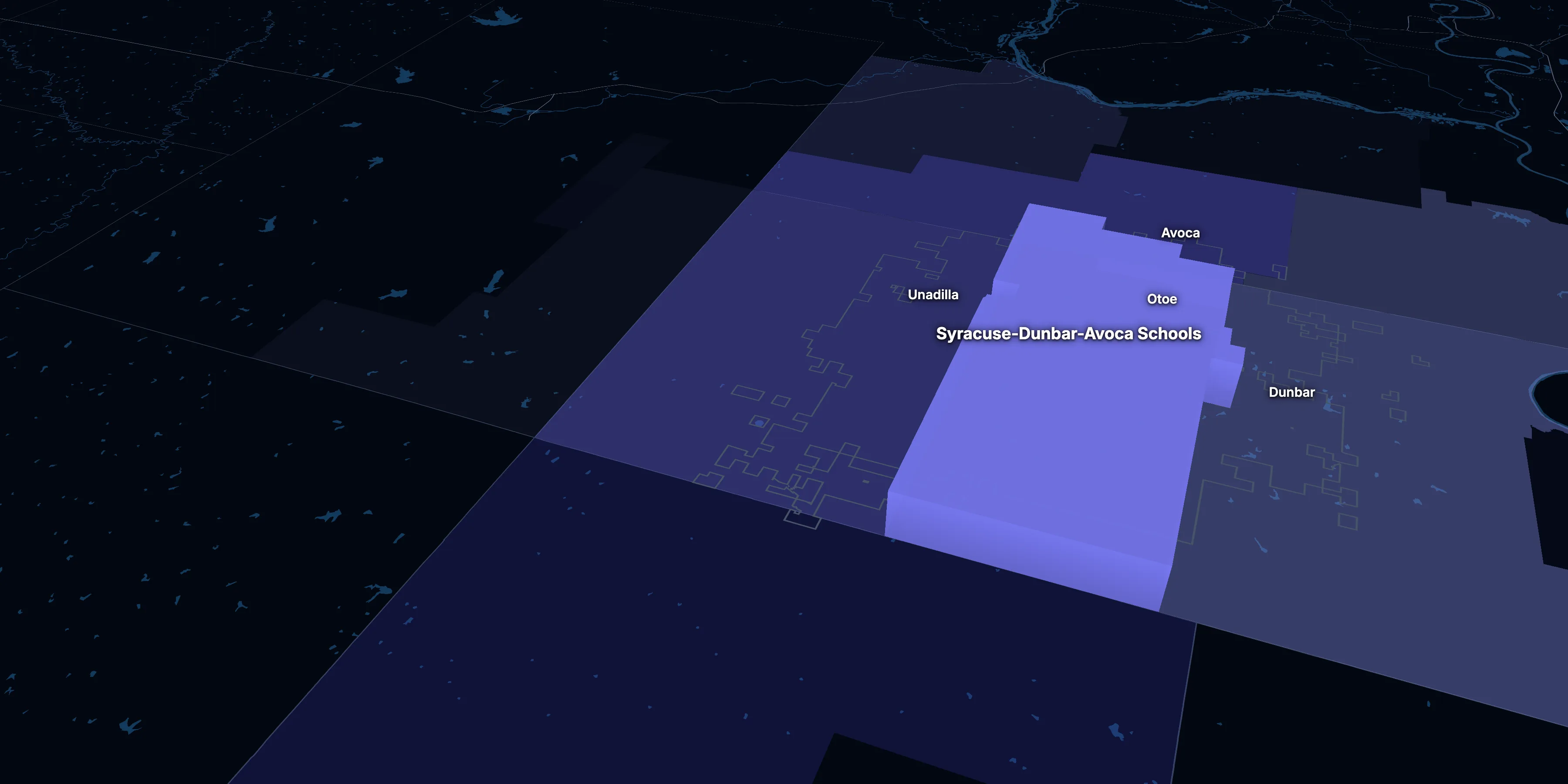
Syracuse-Dunbar-Avoca Schools, Nebraska · population, demographics and census data
Home to 4,642 people, the 54th largest of Nebraska’s 244 school districts, anchored by Syracuse. It grew 3.7% between 2010–2014 and 2020–2024.
- Population
- 4,642 ±330. Rank 54 of 244 in Nebraska
- Median household income
- $84,461 ±$8,220. Nebraska $76,475 · US $80,734
- Median age
- 44.8 ±3.4. Nebraska 37.2 · US 38.9
ACS 2020–2024 5-year estimates, U.S. Census Bureau
About Syracuse-Dunbar-Avoca Schools
Syracuse-Dunbar-Avoca Schools’s median household income is $84,461 (±$8,220), not statistically different from Nebraska ($76,475) but about the same as the US ($80,734), and its median age is 44.8 (±3.4), according to the ACS 2020–2024 5-year estimates. Its largest city is Syracuse.
These figures cover everyone who lives within Syracuse-Dunbar-Avoca Schools’s boundaries, not its enrollment. 793 (±137) children aged 5 to 17 live here, 17.1% (±2.7%) of its residents. 714 (±134) go to public school from kindergarten to 12th grade, and 70 (±43) to private school. 8.5% (±4.7%) of its children live in poverty. All according to the ACS 2020–2024 5-year estimates. For enrollment by school, see the National Center for Education Statistics.
With 4,642 residents, treat these as rough estimates. The survey reaches only a sample of households, so a small place’s figures can swing widely from year to year, and small differences may not mean much.
± is each figure’s margin of error, at 90% confidence, and † marks one too uncertain to lean on. Under each percentage in the tables is the number it counts. How the margins are worked out.
NCES ID 3177550
Highlights
What stands out in Syracuse-Dunbar-Avoca Schools
The numbers where Syracuse-Dunbar-Avoca Schools sits furthest from Nebraska and the nation, or past a recognized policy benchmark.
Past a policy benchmark
39.1%
Very highHomes built before 1960
That’s higher than both Nebraska (31.1%) and the US (25.3%). Older homes carry more lead-paint risk: the EPA found lead paint in 69% of homes built from 1940 to 1959.
Furthest from the national picture
0.4%
Very lowBorn outside the US
That’s lower than both Nebraska (8.0%) and the US (14.1%). It’s the 28th lowest of 206 Nebraska school districts.
$670
Very lowMedian gross rent
That’s lower than both Nebraska ($1,072) and the US ($1,413). It’s the 28th lowest of 206 Nebraska school districts.
15.3%
Very lowHouseholds that rent
That’s lower than both Nebraska (33.5%) and the US (34.8%).
1.2%
Very lowSpeak a language other than English at home
That’s lower than both Nebraska (12.8%) and the US (22.3%). It’s the 17th lowest of 206 Nebraska school districts.
5.3%
Very lowWork from home
That’s lower than both Nebraska (11.0%) and the US (15.1%).
2010–2014 to 2020–2024
How Syracuse-Dunbar-Avoca Schools changed in ten years
The school district added 166 people. It got older and better educated, and poverty fell 1.9 points.
Population, change since 2010–14
+3.7% in the school district, +6.6% in Nebraska and +6.6% in the US.
Source: ACS 5-year, 2010–14 to 2020–24, table A00001.
Show data
| Syracuse-Dunbar-Avoca Schools | Nebraska | United States | |
|---|---|---|---|
| 2010–14 | 0.0% | 0.0% | 0.0% |
| 2011–15 | −5.0% | +0.7% | +0.8% |
| 2012–16 | −3.2% | +1.4% | +1.4% |
| 2013–17 | −1.4% | +2.1% | +2.2% |
| 2014–18 | +2.0% | +2.6% | +2.8% |
| 2015–19 | +1.4% | +3.2% | +3.4% |
| 2016–20 | +3.0% | +3.7% | +4.0% |
| 2017–21 | −2.3% | +5.2% | +5.0% |
| 2018–22 | −0.2% | +5.6% | +5.4% |
| 2019–23 | +0.9% | +5.9% | +5.8% |
| 2020–24 | +3.7% | +6.6% | +6.6% |
Embed
Median household income, in 2024 dollars
+17.9% in the school district, +9.9% in Nebraska and +13.7% in the US.
Source: ACS 5-year, 2010–14 to 2020–24, table A14006.
Show data
| Syracuse-Dunbar-Avoca Schools | Nebraska | United States | |
|---|---|---|---|
| 2010–14 | $71,628 | $69,581 | $71,018 |
| 2011–15 | $70,934 | $70,253 | $71,435 |
| 2012–16 | $71,634 | $71,173 | $72,401 |
| 2013–17 | $75,122 | $72,610 | $73,862 |
| 2014–18 | $74,589 | $73,935 | $75,407 |
| 2015–19 | $74,667 | $75,473 | $77,198 |
| 2016–20 | $80,948 | $76,454 | $78,856 |
| 2017–21 | $83,186 | $77,250 | $80,006 |
| 2018–22 | $83,954 | $76,875 | $80,548 |
| 2019–23 | $84,160 | $77,188 | $80,845 |
| 2020–24 | $84,461 | $76,475 | $80,734 |
Embed
Living in poverty
−1.9 points in the school district, −2.3 points in Nebraska and −3.1 points in the US.
Source: ACS 5-year, 2010–14 to 2020–24, table A13004.
Show data
| Syracuse-Dunbar-Avoca Schools | Nebraska | United States | |
|---|---|---|---|
| 2010–14 | 8.8% | 12.9% | 15.6% |
| 2011–15 | 10.4% | 12.7% | 15.5% |
| 2012–16 | 7.9% | 12.4% | 15.1% |
| 2013–17 | 7.2% | 12.0% | 14.6% |
| 2014–18 | 7.2% | 11.6% | 14.1% |
| 2015–19 | 7.6% | 11.1% | 13.4% |
| 2016–20 | 5.1% | 10.4% | 12.8% |
| 2017–21 | 6.1% | 10.3% | 12.6% |
| 2018–22 | 5.9% | 10.4% | 12.5% |
| 2019–23 | 7.4% | 10.3% | 12.4% |
| 2020–24 | 6.9% | 10.6% | 12.5% |
Embed
Bachelor’s degree or more
+5.5 points in the school district, +5.6 points in Nebraska and +6.4 points in the US.
Source: ACS 5-year, 2010–14 to 2020–24, table A12001.
Show data
| Syracuse-Dunbar-Avoca Schools | Nebraska | United States | |
|---|---|---|---|
| 2010–14 | 20.4% | 29.0% | 29.3% |
| 2011–15 | 18.5% | 29.3% | 29.8% |
| 2012–16 | 18.8% | 30.0% | 30.3% |
| 2013–17 | 20.5% | 30.6% | 30.9% |
| 2014–18 | 22.3% | 31.3% | 31.5% |
| 2015–19 | 25.7% | 31.9% | 32.1% |
| 2016–20 | 28.7% | 32.5% | 32.9% |
| 2017–21 | 29.6% | 32.9% | 33.7% |
| 2018–22 | 26.9% | 33.5% | 34.3% |
| 2019–23 | 27.1% | 34.1% | 35.0% |
| 2020–24 | 25.9% | 34.6% | 35.7% |
Embed
Median gross rent, in 2024 dollars
−25.1% in the school district, +12.0% in Nebraska and +15.6% in the US.
Source: ACS 5-year, 2010–14 to 2020–24, table A18009.
Show data
| Syracuse-Dunbar-Avoca Schools | Nebraska | United States | |
|---|---|---|---|
| 2010–14 | $894 | $957 | $1,222 |
| 2011–15 | $848 | $962 | $1,230 |
| 2012–16 | $849 | $975 | $1,242 |
| 2013–17 | $844 | $990 | $1,258 |
| 2014–18 | $810 | $1,007 | $1,279 |
| 2015–19 | $789 | $1,023 | $1,305 |
| 2016–20 | $846 | $1,040 | $1,330 |
| 2017–21 | $836 | $1,054 | $1,348 |
| 2018–22 | $794 | $1,058 | $1,359 |
| 2019–23 | $787 | $1,065 | $1,388 |
| 2020–24 | $670 | $1,072 | $1,413 |
Embed
Median home value, in 2024 dollars
+27.2% in the school district, +38.1% in Nebraska and +42.6% in the US.
Source: ACS 5-year, 2010–14 to 2020–24, table A10036.
Show data
| Syracuse-Dunbar-Avoca Schools | Nebraska | United States | |
|---|---|---|---|
| 2010–14 | $168,508 | $172,757 | $233,308 |
| 2011–15 | $170,604 | $176,569 | $236,751 |
| 2012–16 | $168,824 | $179,687 | $241,720 |
| 2013–17 | $171,676 | $182,438 | $247,905 |
| 2014–18 | $176,971 | $184,850 | $256,264 |
| 2015–19 | $175,787 | $191,388 | $267,181 |
| 2016–20 | $178,837 | $198,977 | $278,810 |
| 2017–21 | $173,293 | $201,808 | $283,875 |
| 2018–22 | $196,576 | $220,371 | $302,152 |
| 2019–23 | $208,346 | $230,375 | $312,314 |
| 2020–24 | $214,400 | $238,600 | $332,700 |
Embed
ACS 5-year estimates. Each point is the five years ending then, and neighboring points share years. Dollar values are in 2024 dollars. School districts merge, split and trade land, so part of a change can be a new boundary rather than new people.
| Indicator | 2010–2014 | 2020–2024 | Change | Nebraska’s change |
|---|---|---|---|---|
| Population | 4,476 | 4,642 | +3.7% | +6.6% |
| Median age | 42.5 | 44.8 | +2.3 years | +1.0 years |
| 65 and over | 20.8% | 25.7% | +4.9 points | +2.8 points |
| Born outside the US | 0.4% | 0.4% | +0.1 points | +1.6 points |
| Hispanic or Latino | 0.5% | 1.7% | +1.2 points | +3.0 points |
| Median household income | $71,628 | $84,461 | +17.9% | +9.9% |
| Living in poverty | 8.8% | 6.9% | −1.9 points | −2.3 points |
| Bachelor’s degree or more | 20.4% | 25.9% | +5.5 points | +5.6 points |
| Households that rent | 22.8% | 15.3% | −7.6 points | −0.1 points |
| Median gross rent | $894 | $670 | −25.1% | +12.0% |
| Median home value | $168,508 | $214,400 | +27.2% | +38.1% |
1 census tract
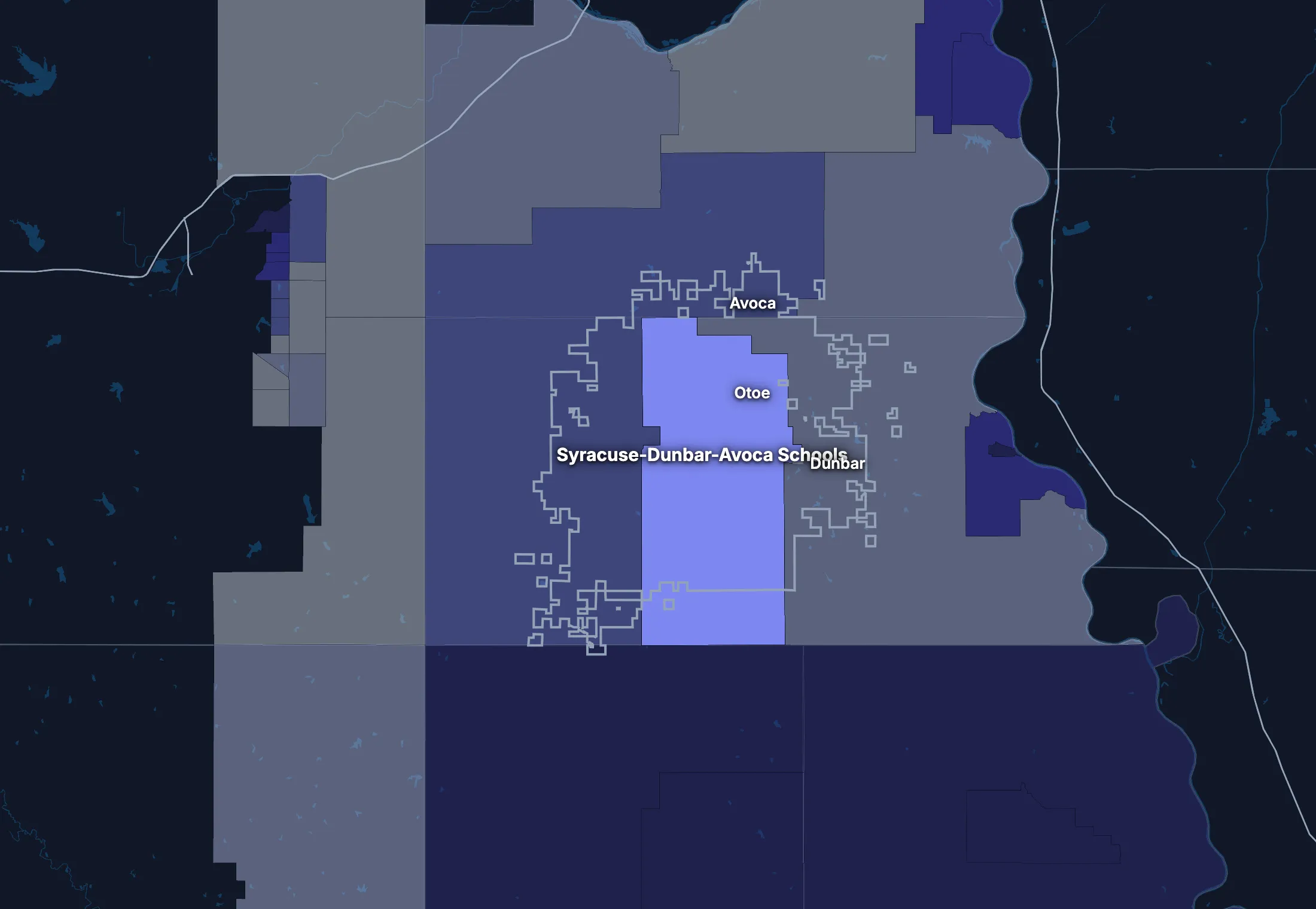
Syracuse-Dunbar-Avoca Schools on the map
Syracuse-Dunbar-Avoca Schools is smaller than a census tract, the smallest area these figures reach, so the map shows the tract it sits in, with the land around it.
People
Who lives in Syracuse-Dunbar-Avoca Schools
An older school district than Nebraska (37.2) or the US (38.9), with a median age of 44.8.
Age
Source: ACS 2020–2024 5-year, table A01001.
Show data
| Syracuse-Dunbar-Avoca Schools | Nebraska | United States | |
|---|---|---|---|
| Under 18 | 23.3% ±3.1% , number 1,080 ±162 | 24.5% ±0.1% , number 484,749 ±2,871 | 22.0% ±<0.1% , number 73,517,834 ±38,890 |
| 18 to 24 | 3.3% ±1.3% , number 151 ±63 | 9.8% ±0.1% , number 193,548 ±2,648 | 9.1% ±<0.1% , number 30,597,362 ±37,780 |
| 25 to 34 | 12.1% ±1.8% , number 561 ±94 | 12.9% ±<0.1% , number 254,673 ±832 | 13.7% ±<0.1% , number 45,806,540 ±10,200 |
| 35 to 44 | 11.7% ±2.4% , number 545 ±117 | 13.1% ±0.1% , number 258,557 ±2,721 | 13.2% ±<0.1% , number 44,237,292 ±43,510 |
| 45 to 54 | 10.8% ±1.9% , number 502 ±94 | 11.1% ±<0.1% , number 220,530 ±798 | 12.2% ±<0.1% , number 40,743,799 ±8,564 |
| 55 to 64 | 13.2% ±2.8% , number 611 ±135 | 11.9% ±0.1% , number 235,845 ±2,581 | 12.7% ±<0.1% , number 42,386,044 ±41,500 |
| 65 to 74 | 11.7% ±1.8% , number 543 ±91 | 9.9% ±0.1% , number 196,312 ±2,319 | 10.2% ±<0.1% , number 34,092,907 ±38,800 |
| 75 and over | 14.0% ±2.7% , number 649 ±133 | 6.8% ±0.1% , number 134,493 ±1,713 | 7.0% ±<0.1% , number 23,540,721 ±31,560 |
Embed
Race and ethnicity
Source: ACS 2020–2024 5-year, table A04001.
Show data
| Syracuse-Dunbar-Avoca Schools | Nebraska | United States | |
|---|---|---|---|
| White, not Hispanic | 94.4% ±1.6% , number 4,381 ±320 | 75.3% ±0.1% , number 1,489,928 ±1,771 | 57.4% ±<0.1% , number 192,214,378 ±30,950 |
| Hispanic or Latino | 1.7% ±1.5% , number 77 ±71 | 12.7% ±<0.1% , number 252,023 ±34 | 19.3% ±<0.1% , number 64,759,370 ±1,547 |
| Black, not Hispanic | 0.1% ±0.2% , number 5 ±8 | 4.6% ±0.1% , number 90,861 ±1,610 | 11.9% ±<0.1% , number 39,896,127 ±46,710 |
| Asian, not Hispanic | 0.0% ±0.1% , number 2 ±4 | 2.6% ±0.1% , number 50,564 ±1,079 | 5.9% ±<0.1% , number 19,678,814 ±22,770 |
| Other or multiracial | 3.8% ±1.8% , number 177 ±82 | 4.8% ±0.1% , number 95,331 ±2,518 | 5.5% ±<0.1% , number 18,373,810 ±69,180 |
Embed
Language spoken at home
Source: ACS 2020–2024 5-year, table C16001.
Show data
| Syracuse-Dunbar-Avoca Schools | Nebraska | United States | |
|---|---|---|---|
| English only | 98.8% ±9.7% , number 4,304 ±299 | 87.2% ±0.2% , number 1,616,628 ±3,788 | 77.7% ±0.1% , number 245,767,039 ±221,000 |
| Spanish | 0.7% ±0.7% , number 32 ±31 | 8.4% ±0.1% , number 156,178 ±2,411 | 13.6% ±<0.1% , number 42,869,908 ±143,800 |
| Other Indo-European | 0.4% ±0.5% , number 17 ±21 | 1.7% ±0.1% , number 32,157 ±2,248 | 3.9% ±<0.1% , number 12,249,474 ±54,760 |
| Asian and Pacific Island | 0.0% ±0.5% , number 2 ±20 | 1.7% ±0.1% , number 31,129 ±1,796 | 3.6% ±<0.1% , number 11,320,253 ±40,030 |
| Arabic and other | 0.0% ±0.3% , number 0 ±14 | 0.9% ±0.1% , number 17,240 ±1,735 | 1.2% ±<0.1% , number 3,935,874 ±33,550 |
Embed
Marital status
Source: ACS 2020–2024 5-year, table A11001.
Show data
| Syracuse-Dunbar-Avoca Schools | Nebraska | United States | |
|---|---|---|---|
| Now married | 60.6% ±3.1% , number 2,313 ±197 | 51.7% ±0.3% , number 816,053 ±4,670 | 47.8% ±0.1% , number 131,199,078 ±272,700 |
| Never married | 20.2% ±3.3% , number 772 ±135 | 31.7% ±0.3% , number 500,336 ±4,081 | 34.4% ±0.1% , number 94,480,845 ±211,900 |
| Divorced | 9.8% ±2.5% , number 375 ±98 | 10.3% ±0.2% , number 162,237 ±2,816 | 10.6% ±<0.1% , number 29,074,059 ±73,390 |
| Widowed | 8.9% ±2.5% , number 340 ±98 | 5.4% ±0.1% , number 84,735 ±1,610 | 5.6% ±<0.1% , number 15,250,943 ±26,710 |
| Separated | 0.4% ±0.4% , number 16 ±16 | 1.0% ±0.1% , number 15,906 ±993 | 1.7% ±<0.1% , number 4,592,038 ±29,170 |
Embed
Where people lived a year ago
Source: ACS 2020–2024 5-year, table A08001.
Show data
| Syracuse-Dunbar-Avoca Schools | Nebraska | United States | |
|---|---|---|---|
| Same home | 93.8% ±3.1% , number 4,297 ±339 | 86.8% ±0.3% , number 1,696,609 ±5,539 | 87.7% ±0.1% , number 290,692,803 ±173,800 |
| Same county | 0.7% ±0.4% , number 30 ±20 | 7.0% ±0.2% , number 135,932 ±4,284 | 6.3% ±<0.1% , number 20,792,831 ±117,600 |
| Another county in the state | 4.1% ±2.4% , number 187 ±111 | 3.3% ±0.1% , number 64,789 ±2,694 | 3.1% ±<0.1% , number 10,316,864 ±51,200 |
| Another state | 1.5% ±1.0% , number 67 ±46 | 2.4% ±0.1% , number 46,611 ±2,107 | 2.3% ±<0.1% , number 7,577,400 ±40,570 |
| Another country | 0.0% ±0.2% , number 0 ±10 | 0.5% ±0.1% , number 10,662 ±1,277 | 0.6% ±<0.1% , number 2,060,087 ±23,560 |
Embed
Top countries of birth, among those born abroad
Source: ACS 2020–2024 5-year, table A07001.
Show data
| Syracuse-Dunbar-Avoca Schools | |
|---|---|
| Philippines | 73.7% , number 14 |
| Colombia | 15.8% , number 3 |
| Japan | 10.5% , number 2 |
Embed
All the numbers
| Indicator | Syracuse-Dunbar-Avoca Schools | Nebraska | US | Rank in Nebraska* | Table |
|---|---|---|---|---|---|
| Population | 4,642 ±330 | 1,978,707 | 334,922,499 | 54th | A00001 |
| People per square mile | 18 ±1 | 26 | 95 | 63rd | A00002 |
| Land area (square miles) | 252 | – | – | – | A00002 |
| Median age | 44.8 ±3.4 | 37.2 ±0.2 | 38.9 ±0.1 | 56th | A01004 |
| Under 18 | 23.3% ±3.1% , number 1,080 ±162 | 24.5% ±0.1% , number 484,749 ±2,871 | 22.0% ±<0.1% , number 73,517,834 ±38,890 | 113th | B02002 |
| 65 and over | 25.7% ±2.9% , number 1,192 ±161 | 16.7% ±0.1% , number 330,805 ±2,883 | 17.2% ±<0.1% , number 57,633,628 ±50,010 | 42nd | B02002 |
| Born outside the US | 0.4%† (too uncertain to lean on) ±0.7% , number 19 ±32 | 8.0% ±0.2% , number 159,084 ±3,474 | 14.1% ±<0.1% , number 47,349,078 ±143,600 | 179th | A06001 |
| Speak a language other than English at home | 1.2%† (too uncertain to lean on) ±9.7% , number 51 ±45 | 12.8% ±0.2% , number 236,704 ±4,135 | 22.3% ±0.1% , number 70,375,509 ±162,500 | 190th | C16001 |
| Veterans (adults) | 9.8% ±2.5% , number 350 ±91 | 6.9% ±0.1% , number 102,710 ±1,710 | 6.2% ±<0.1% , number 16,185,883 ±45,250 | 25th | A16002 |
| Living with a disability | 14.3% ±2.8% , number 655 ±137 | 12.3% ±0.2% , number 240,525 ±3,112 | 13.3% ±<0.1% , number 43,869,797 ±68,920 | 79th | B18101 |
| Women 15–50 who had a baby in the past year | 7.3% ±4.2% , number 62 ±37 | 5.8% ±0.3% , number 26,331 ±1,201 | 5.1% ±<0.1% , number 4,009,203 ±20,900 | 79th | B13002 |
| Lived in the same home a year ago | 93.8% ±3.1% , number 4,297 ±339 | 86.8% ±0.3% , number 1,696,609 ±5,539 | 87.7% ±0.1% , number 290,692,803 ±173,800 | 52nd | A08001 |
| White, not Hispanic | 94.4% ±1.6% , number 4,381 ±320 | 75.3% ±0.1% , number 1,489,928 ±1,771 | 57.4% ±<0.1% , number 192,214,378 ±30,950 | 38th | A04001 |
| Hispanic or Latino | 1.7%† (too uncertain to lean on) ±1.5% , number 77 ±71 | 12.7% ±<0.1% , number 252,023 ±34 | 19.3% ±<0.1% , number 64,759,370 ±1,547 | 181st | A04001 |
| Black, not Hispanic | 0.1%† (too uncertain to lean on) ±0.2% , number 5 ±8 | 4.6% ±0.1% , number 90,861 ±1,610 | 11.9% ±<0.1% , number 39,896,127 ±46,710 | 123rd | A04001 |
| Asian, not Hispanic | 0.0%† (too uncertain to lean on) ±0.1% , number 2 ±4 | 2.6% ±0.1% , number 50,564 ±1,079 | 5.9% ±<0.1% , number 19,678,814 ±22,770 | 137th | A04001 |
*1 is the highest. Population is ranked among all school districts, and the rest among those of 1,000 people or more, whose figures can be ranked. Ranks use 5-year estimates, the only ones covering every school district, so they can differ slightly from the figures here.
Income and work
Income and work
The median household income is $84,461, not statistically different from Nebraska ($76,475) but about the same as the US ($80,734). 6.9% of people live in poverty, and 4.8% have no health insurance, lower than both Nebraska (7.2%) and the US (8.4%).
Household income
Source: ACS 2020–2024 5-year, table A14001.
Show data
| Syracuse-Dunbar-Avoca Schools | Nebraska | United States | |
|---|---|---|---|
| Under $25,000 | 14.2% ±4.3% , number 280 ±86 | 13.8% ±0.3% , number 110,465 ±2,402 | 14.6% ±<0.1% , number 18,908,588 ±41,540 |
| $25,000 to $49,999 | 14.7% ±3.3% , number 290 ±68 | 18.0% ±0.3% , number 143,248 ±2,697 | 16.7% ±<0.1% , number 21,624,902 ±39,130 |
| $50,000 to $74,999 | 14.5% ±3.8% , number 286 ±77 | 17.3% ±0.3% , number 138,227 ±2,722 | 15.5% ±<0.1% , number 20,031,683 ±36,850 |
| $75,000 to $99,999 | 14.7% ±4.6% , number 291 ±93 | 13.5% ±0.3% , number 108,062 ±2,520 | 12.6% ±<0.1% , number 16,319,799 ±42,700 |
| $100,000 to $149,999 | 24.1% ±5.5% , number 476 ±113 | 18.9% ±0.3% , number 150,509 ±2,618 | 17.5% ±<0.1% , number 22,670,921 ±58,280 |
| $150,000 to $199,999 | 12.6% ±4.0% , number 249 ±80 | 9.1% ±0.2% , number 72,219 ±1,478 | 9.6% ±<0.1% , number 12,405,370 ±57,560 |
| $200,000 or more | 5.4% ±2.5% , number 106 ±49 | 9.4% ±0.2% , number 75,117 ±1,872 | 13.4% ±0.1% , number 17,266,233 ±82,370 |
Embed
What residents do for work
Source: ACS 2020–2024 5-year, table A17004.
Show data
| Syracuse-Dunbar-Avoca Schools | Nebraska | United States | |
|---|---|---|---|
| Education and health care | 24.9% ±5.4% , number 552 ±128 | 24.5% ±0.3% , number 250,602 ±3,343 | 23.5% ±0.1% , number 37,913,663 ±133,200 |
| Agriculture and mining | 11.0% ±4.1% , number 244 ±94 | 4.3% ±0.1% , number 43,663 ±1,191 | 1.6% ±<0.1% , number 2,511,442 ±17,160 |
| Retail trade | 10.0% ±4.1% , number 221 ±92 | 10.6% ±0.2% , number 108,371 ±2,265 | 10.8% ±<0.1% , number 17,456,908 ±41,100 |
| Transportation and warehousing | 9.1% ±2.5% , number 203 ±58 | 6.0% ±0.2% , number 61,095 ±1,661 | 5.9% ±<0.1% , number 9,568,767 ±29,300 |
| Manufacturing | 8.0% ±3.6% , number 178 ±82 | 10.4% ±0.2% , number 106,576 ±2,194 | 9.9% ±<0.1% , number 15,940,000 ±38,890 |
| Finance, insurance and real estate | 7.7% ±2.6% , number 171 ±59 | 7.8% ±0.2% , number 80,166 ±1,982 | 6.7% ±<0.1% , number 10,783,159 ±41,000 |
| Other services | 6.0% ±2.9% , number 133 ±66 | 4.7% ±0.2% , number 47,659 ±1,788 | 4.7% ±<0.1% , number 7,588,496 ±24,900 |
| Arts, food and lodging | 5.9% ±2.5% , number 131 ±56 | 7.3% ±0.2% , number 75,011 ±2,266 | 8.7% ±<0.1% , number 13,952,453 ±52,980 |
Embed
All the numbers
| Indicator | Syracuse-Dunbar-Avoca Schools | Nebraska | US | Rank in Nebraska* | Table |
|---|---|---|---|---|---|
| Median household income | $84,461 ±$8,220 | $76,475 ±$633 | $80,734 ±$166 | 50th | A14006 |
| Income per person | $43,677 ±$4,287 | $41,751 ±$384 | $44,673 ±$122 | 46th | A14024 |
| Income inequality (Gini index) | 0.415 ±0.043 | 0.456 ±0.003 | 0.483 | 107th | A14028 |
| Living in poverty | 6.9% ±2.0% , number 316 ±94 | 10.6% ±0.3% , number 204,630 ±5,789 | 12.5% ±0.1% , number 40,735,661 ±275,900 | 131st | A13004 |
| Unemployment rate | 2.8%† (too uncertain to lean on) ±2.5% , number 63 ±58 | 3.0% ±0.1% , number 32,072 ±1,319 | 5.2% ±<0.1% , number 8,902,365 ±38,980 | 61st | A17005 |
| No health insurance | 4.8% ±2.2% , number 221 ±102 | 7.2% ±0.2% , number 139,810 ±2,970 | 8.4% ±<0.1% , number 27,734,911 ±158,900 | 138th | A20001 |
*1 is the highest. Population is ranked among all school districts, and the rest among those of 1,000 people or more, whose figures can be ranked. Ranks use 5-year estimates, the only ones covering every school district, so they can differ slightly from the figures here.
Education
Fewer college degrees than the US
25.9% of adults 25 and over have a bachelor’s degree or more, lower than both Nebraska (34.6%) and the US (35.7%).
Highest level of education
Source: ACS 2020–2024 5-year, table A12001.
Show data
| Syracuse-Dunbar-Avoca Schools | Nebraska | United States | |
|---|---|---|---|
| Less than high school | 4.3% ±2.0% , number 147 ±69 | 7.8% ±0.2% , number 101,586 ±2,628 | 10.4% ±<0.1% , number 23,992,410 ±82,490 |
| High school only | 35.4% ±4.0% , number 1,206 ±160 | 25.0% ±0.3% , number 325,460 ±4,117 | 26.0% ±0.1% , number 60,094,716 ±262,500 |
| Some college | 34.5% ±4.8% , number 1,176 ±184 | 32.6% ±0.4% , number 423,713 ±4,625 | 27.9% ±0.1% , number 64,356,961 ±143,900 |
| Bachelor’s degree | 17.6% ±3.0% , number 599 ±112 | 22.3% ±0.3% , number 289,562 ±3,770 | 21.6% ±0.1% , number 49,868,171 ±191,400 |
| Graduate degree | 8.3% ±2.5% , number 283 ±88 | 12.3% ±0.2% , number 160,089 ±2,917 | 14.1% ±0.1% , number 32,495,045 ±159,600 |
Embed
All the numbers
| Indicator | Syracuse-Dunbar-Avoca Schools | Nebraska | US | Rank in Nebraska* | Table |
|---|---|---|---|---|---|
| Bachelor’s degree or more | 25.9% ±3.8% , number 882 ±142 | 34.6% ±0.4% , number 449,651 ±4,767 | 35.7% ±0.1% , number 82,363,216 ±249,200 | 84th | A12001 |
| High school graduate or more | 95.7% ±4.8% , number 3,264 ±282 | 92.2% ±0.6% , number 1,198,824 ±7,814 | 89.6% ±0.2% , number 206,814,893 ±389,500 | 60th | A12001 |
*1 is the highest. Population is ranked among all school districts, and the rest among those of 1,000 people or more, whose figures can be ranked. Ranks use 5-year estimates, the only ones covering every school district, so they can differ slightly from the figures here.
Housing
Home values kept pace with incomes
15.3% of households rent, lower than both Nebraska (33.5%) and the US (34.8%). The median home is worth $214,400 and the median rent is $670. After inflation, home values rose 27% from 2010–2014 to 2020–2024, while household income rose 18%.
Housing costs and income, 2010–2014 to 2020–2024, after inflation
Source: ACS 5-year, table A10036, A18009, A14006.
Show data
| Syracuse-Dunbar-Avoca Schools | Nebraska | United States | |
|---|---|---|---|
| Median home value | +27.2% | +38.1% | +42.6% |
| Median rent | −25.1% | +12.0% | +15.6% |
| Median household income | +17.9% | +9.9% | +13.7% |
Embed
Types of homes
Source: ACS 2020–2024 5-year, table A10032.
Show data
| Syracuse-Dunbar-Avoca Schools | Nebraska | United States | |
|---|---|---|---|
| Single-family, detached | 90.7% ±3.6% , number 1,930 ±160 | 71.3% ±0.3% , number 615,689 ±2,871 | 61.3% ±0.1% , number 88,075,458 ±149,800 |
| Single-family, attached | 2.0% ±1.2% , number 43 ±25 | 4.1% ±0.2% , number 35,008 ±1,396 | 6.2% ±<0.1% , number 8,955,086 ±33,580 |
| 2 to 4 units | 1.4% ±1.3% , number 30 ±28 | 4.3% ±0.2% , number 37,342 ±1,395 | 7.7% ±<0.1% , number 11,031,346 ±42,810 |
| 5 to 19 units | 4.0% ±2.4% , number 85 ±51 | 9.2% ±0.3% , number 79,185 ±2,350 | 8.8% ±<0.1% , number 12,625,154 ±51,990 |
| 20 or more units | 0.9% ±1.2% , number 19 ±25 | 8.2% ±0.2% , number 70,777 ±2,021 | 10.3% ±<0.1% , number 14,859,547 ±31,000 |
| Mobile homes and other | 1.0% ±0.8% , number 22 ±18 | 2.9% ±0.1% , number 25,443 ±1,065 | 5.7% ±<0.1% , number 8,228,764 ±48,580 |
Embed
When homes were built
Source: ACS 2020–2024 5-year, table A10055.
Show data
| Syracuse-Dunbar-Avoca Schools | Nebraska | United States | |
|---|---|---|---|
| 2010 or later | 5.7% ±3.1% , number 112 ±61 | 11.6% ±0.3% , number 92,478 ±2,037 | 11.6% ±<0.1% , number 14,996,534 ±51,640 |
| 2000 to 2009 | 18.3% ±5.2% , number 361 ±105 | 11.9% ±0.3% , number 94,967 ±2,097 | 13.8% ±<0.1% , number 17,865,859 ±70,250 |
| 1980 to 1999 | 14.0% ±4.8% , number 277 ±97 | 20.2% ±0.3% , number 161,394 ±2,754 | 25.3% ±<0.1% , number 32,758,140 ±75,080 |
| 1960 to 1979 | 23.0% ±4.4% , number 454 ±92 | 25.2% ±0.4% , number 201,215 ±2,958 | 23.9% ±<0.1% , number 30,938,809 ±78,560 |
| Before 1960 | 39.1% ±4.8% , number 774 ±108 | 31.1% ±0.4% , number 247,793 ±3,334 | 25.3% ±<0.1% , number 32,668,154 ±83,060 |
Embed
All the numbers
| Indicator | Syracuse-Dunbar-Avoca Schools | Nebraska | US | Rank in Nebraska* | Table |
|---|---|---|---|---|---|
| Housing units | 2,129 ±155 | – | – | – | A10001 |
| Households | 1,978 ±131 | – | – | – | A10008 |
| People per household | 2.32 ±0.13 | 2.42 ±0.01 | 2.53 ±0.01 | 139th | A10003 |
| Households that rent | 15.3% ±3.8% , number 302 ±77 | 33.5% ±0.4% , number 266,969 ±3,420 | 34.8% ±0.1% , number 45,017,354 ±163,600 | 159th | A10060 |
| Vacant homes | 7.1% ±3.5% , number 151 ±76 | 7.6% ±0.3% , number 65,597 ±2,361 | 10.1% ±0.1% , number 14,547,859 ±200,400 | 150th | A10047, A10060 |
| Median gross rent | $670 ±$60 | $1,072 ±$8 | $1,413 ±$2 | 179th | A18009 |
| Median home value | $214,400 ±$15,450 | $238,600 ±$1,365 | $332,700 ±$236 | 60th | A10036 |
| Renters paying 30% or more of income | 25.2% ±12.8% , number 76 ±43 | 41.9% ±0.8% , number 111,902 ±2,611 | 47.6% ±0.2% , number 21,422,415 ±63,960 | 111th | A18002 |
| Owners paying 30% or more of income | 14.6% ±4.4% , number 245 ±76 | 18.2% ±0.3% , number 96,575 ±1,973 | 22.5% ±0.1% , number 18,961,895 ±39,930 | 144th | A10040 |
| Homes built before 1960 | 39.1% ±4.8% , number 774 ±108 | 31.1% ±0.4% , number 247,793 ±3,334 | 25.3% ±<0.1% , number 32,668,154 ±83,060 | 143rd | A10055 |
*1 is the highest. Population is ranked among all school districts, and the rest among those of 1,000 people or more, whose figures can be ranked. Ranks use 5-year estimates, the only ones covering every school district, so they can differ slightly from the figures here.
Getting around
A driving school district
81.2% of workers drive alone and 5.3% work from home. 44.2% of those who travel to work spend 30 minutes or more getting there, and 4.7% of households have no vehicle.
How people get to work
Source: ACS 2020–2024 5-year, table A09005.
Show data
| Syracuse-Dunbar-Avoca Schools | Nebraska | United States | |
|---|---|---|---|
| Drive alone | 81.2% ±3.2% , number 1,793 ±165 | 76.1% ±0.3% , number 771,030 ±4,387 | 68.8% ±0.1% , number 109,447,738 ±95,800 |
| Carpool | 8.9% ±3.4% , number 197 ±77 | 8.7% ±0.2% , number 87,876 ±2,314 | 8.5% ±<0.1% , number 13,569,614 ±52,500 |
| Public transit | 0.1% ±0.5% , number 2 ±10 | 0.6% ±0.1% , number 5,938 ±707 | 3.5% ±<0.1% , number 5,573,279 ±22,170 |
| Walk | 4.3% ±2.7% , number 95 ±60 | 2.3% ±0.1% , number 23,584 ±1,246 | 2.4% ±<0.1% , number 3,772,609 ±17,080 |
| Work from home | 5.3% ±2.5% , number 118 ±56 | 11.0% ±0.3% , number 112,009 ±2,739 | 15.1% ±<0.1% , number 24,042,489 ±82,860 |
| Other | 0.1% ±0.7% , number 3 ±16 | 1.3% ±0.1% , number 13,291 ±911 | 1.7% ±<0.1% , number 2,708,365 ±17,940 |
Embed
Time spent getting to work
Source: ACS 2020–2024 5-year, table B09001.
Show data
| Syracuse-Dunbar-Avoca Schools | Nebraska | United States | |
|---|---|---|---|
| Under 10 minutes | 25.6% ±5.1% , number 536 ±116 | 23.3% ±0.4% , number 210,020 ±3,416 | 12.7% ±<0.1% , number 17,153,542 ±40,730 |
| 10 to 19 minutes | 19.8% ±5.2% , number 413 ±115 | 35.7% ±0.5% , number 322,270 ±4,533 | 28.7% ±<0.1% , number 38,741,521 ±54,980 |
| 20 to 29 minutes | 10.4% ±3.0% , number 218 ±65 | 21.4% ±0.4% , number 192,791 ±3,332 | 21.3% ±<0.1% , number 28,723,420 ±52,330 |
| 30 to 39 minutes | 16.3% ±4.3% , number 340 ±95 | 10.8% ±0.2% , number 97,001 ±2,210 | 16.9% ±<0.1% , number 22,853,044 ±46,230 |
| 40 to 59 minutes | 20.3% ±5.5% , number 424 ±121 | 5.3% ±0.2% , number 47,517 ±1,582 | 11.9% ±<0.1% , number 16,024,037 ±44,090 |
| 60 minutes or more | 7.6% ±3.3% , number 159 ±71 | 3.6% ±0.2% , number 32,120 ±1,417 | 8.6% ±<0.1% , number 11,576,041 ±36,550 |
Embed
Vehicles per household
Source: ACS 2020–2024 5-year, table A10030.
Show data
| Syracuse-Dunbar-Avoca Schools | Nebraska | United States | |
|---|---|---|---|
| None | 4.7% ±2.2% , number 92 ±45 | 5.4% ±0.2% , number 43,250 ±1,598 | 8.4% ±<0.1% , number 10,793,323 ±36,450 |
| One | 19.1% ±4.8% , number 377 ±99 | 30.1% ±0.4% , number 240,306 ±3,362 | 33.1% ±0.1% , number 42,801,892 ±122,600 |
| Two | 43.1% ±6.2% , number 853 ±135 | 37.7% ±0.5% , number 300,828 ±3,856 | 36.6% ±0.1% , number 47,334,152 ±191,100 |
| Three or more | 33.2% ±6.4% , number 656 ±135 | 26.8% ±0.4% , number 213,463 ±2,932 | 21.9% ±0.1% , number 28,298,129 ±85,940 |
Embed
All the numbers
| Indicator | Syracuse-Dunbar-Avoca Schools | Nebraska | US | Rank in Nebraska* | Table |
|---|---|---|---|---|---|
| Drive to work alone | 81.2% ±3.2% , number 1,793 ±165 | 76.1% ±0.3% , number 771,030 ±4,387 | 68.8% ±0.1% , number 109,447,738 ±95,800 | 66th | A09005 |
| Take public transit | 0.1%† (too uncertain to lean on) ±0.5% , number 2 ±10 | 0.6% ±0.1% , number 5,938 ±707 | 3.5% ±<0.1% , number 5,573,279 ±22,170 | 49th | A09005 |
| Work from home | 5.3% ±2.5% , number 118 ±56 | 11.0% ±0.3% , number 112,009 ±2,739 | 15.1% ±<0.1% , number 24,042,489 ±82,860 | 157th | A09005 |
| Commute 30 minutes or more | 44.2% ±7.1% , number 923 ±169 | 19.6% ±0.3% , number 176,638 ±3,066 | 37.4% ±<0.1% , number 50,453,122 ±73,600 | 13th | B09001 |
| Households with no vehicle | 4.7% ±2.4% , number 92 ±48 | 5.4% ±0.2% , number 43,250 ±1,619 | 8.4% ±<0.1% , number 10,793,323 ±27,220 | 59th | A10030 |
*1 is the highest. Population is ranked among all school districts, and the rest among those of 1,000 people or more, whose figures can be ranked. Ranks use 5-year estimates, the only ones covering every school district, so they can differ slightly from the figures here.
Places
In and around Syracuse-Dunbar-Avoca Schools
Population, from the latest estimates available. Figures cover the whole of each place, including any part outside the school district.
Its county
- Otoe County: 16,241
School districts like this one
- Pecatonica Community Unit School District 321, IL: 4,997
- Berne Union Local School District, OH: 4,923
- Cole County R-V School District, MO: 4,923
- Deuel School District 19-4, SD: 3,303
School districts at least a third this size, with the closest income, education, age, housing and origins.
Turn Syracuse-Dunbar-Avoca Schools into your planning report.
Social Explorer Studio builds an editable profile of any place, with tables and charts beside the county and state, and exports to Word, PDF and Excel.
Questions about Syracuse-Dunbar-Avoca Schools
What is the population of Syracuse-Dunbar-Avoca Schools, Nebraska?
4,642 people (±330), according to the ACS 2020–2024 5-year estimates. That’s the 54th largest of 244 school districts in Nebraska.
How many school-age children live in Syracuse-Dunbar-Avoca Schools?
793 (±137) children aged 5 to 17, according to the ACS 2020–2024 5-year estimates. 714 (±134) go to public school from kindergarten to 12th grade, and 70 (±43) to private school. 8.5% (±4.7%) of them live in poverty. These count the children who live in the district, not its enrollment.
What is the NCES ID for Syracuse-Dunbar-Avoca Schools?
3177550, the district’s number at the National Center for Education Statistics, which the Census Bureau uses too. The first two digits, 31, are Nebraska’s state code. A unified school district teaches every grade.
What county is Syracuse-Dunbar-Avoca Schools in?
Syracuse-Dunbar-Avoca Schools is in Otoe County.
What is the largest city in Syracuse-Dunbar-Avoca Schools?
Syracuse, with 1,990 people. Other large places here include Unadilla, Dunbar and Avoca. These figures cover the whole of each place, including any part outside the school district.
What is the median household income in Syracuse-Dunbar-Avoca Schools?
$84,461 (±$8,220), according to the ACS 2020–2024 5-year estimates, not statistically different from Nebraska ($76,475) but about the same as the US ($80,734).
What is the median age in Syracuse-Dunbar-Avoca Schools?
44.8 years (±3.4), according to the ACS 2020–2024 5-year estimates, higher than both Nebraska (37.2) and the US (38.9).
How much does housing cost in Syracuse-Dunbar-Avoca Schools?
Syracuse-Dunbar-Avoca Schools’s median home value is $214,400 (±$15,450) and its median gross rent is $670 (±$60) a month, according to the ACS 2020–2024 5-year estimates. 25.2% (±12.8%) of its renters pay 30% or more of their income on rent.
Is Syracuse-Dunbar-Avoca Schools growing?
Syracuse-Dunbar-Avoca Schools’s population grew 3.7%, from 4,476 in 2010–2014 to 4,642 in 2020–2024, according to the ACS 5-year estimates.
Where does this census data come from?
The U.S. Census Bureau’s American Community Survey, through Social Explorer’s tables: the latest 1-year estimates where they exist, for the most recent numbers, and 5-year estimates otherwise. Each table lists its code, so you can find it again.
Is this data free to use?
Yes. You can read it, cite it, download the CSV and embed the charts, with no account. To map other variables, compare your own areas or build a report, see Social Explorer’s plans in a live demo.
Sources and how to cite
American Community Survey 2020–2024 5-year estimates, U.S. Census Bureau, from Social Explorer’s tables A00001, A00002, A01004, A04001, A06001, A08001, A09005, A10001, A10003, A10008, A10030, A10036, A10040, A10047, A10055, A10060, A12001, A13004, A14006, A14024, A14028, A16002, A17005, A18002, A18009, A20001, B02002, B09001, B13002, B18101, C16001. Maps by census tract use 2020–2024 5-year estimates, since the 1-year survey doesn’t cover tracts. These are estimates from a sample, each with its margin of error. Data retrieved November 14, 2026. How these profiles are made.
U.S. Census Bureau, American Community Survey 2020–2024 5-year estimates, via Social Explorer. “Syracuse-Dunbar-Avoca Schools, Nebraska.” https://www.socialexplorer.com/places/nebraska/syracuse-dunbar-avoca-schools. Accessed November 14, 2026.