

Fort Dodge urban area, Iowa · population, demographics and census data
Home to 24,715 people, the 14th largest of Iowa’s 69 urban areas.
- Population
- 24,715 ±152. Rank 14 of 69 in Iowa
- Median household income
- $60,318 ±$6,998. Iowa $75,059 · US $80,734
- Median age
- 37.3 ±1.5. Iowa 38.6 · US 38.9
ACS 2020–2024 5-year estimates, U.S. Census Bureau
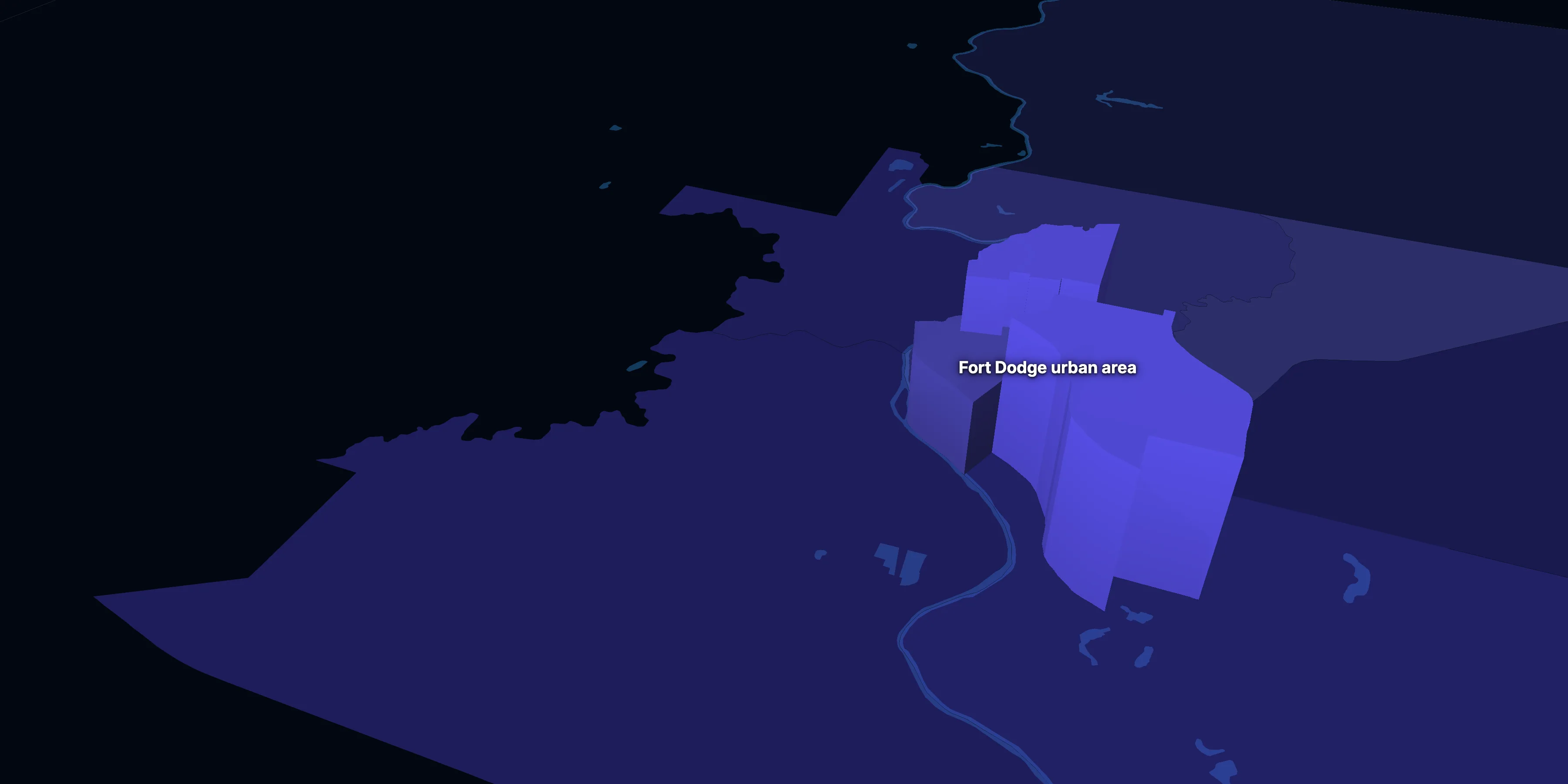
Taller, lighter tracts have higher household incomes
About the Fort Dodge urban area
The Fort Dodge urban area’s median household income is $60,318 (±$6,998), lower than both Iowa ($75,059) and the US ($80,734), and its median age is 37.3 (±1.5), according to the ACS 2020–2024 5-year estimates.
± is each figure’s margin of error, at 90% confidence, and † marks one too uncertain to lean on. Under each percentage in the tables is the number it counts. How the margins are worked out.
Urban area code 30682
Highlights
What stands out in the Fort Dodge urban area
The numbers where the Fort Dodge urban area sits furthest from Iowa and the nation, or past a recognized policy benchmark.
Past a policy benchmark
55.2%
Very highHomes built before 1960
That’s higher than both Iowa (36.9%) and the US (25.3%). Older homes carry more lead-paint risk: the EPA found lead paint in 69% of homes built from 1940 to 1959.
15.8%
ElevatedLiving in poverty
That’s higher than both Iowa (11.1%) and the US (12.5%). HUD and the New Markets Tax Credit use 20% poverty to mark low-income areas.
Furthest from the national picture
4.4%
Very lowWork from home
That’s lower than both Iowa (11.3%) and the US (15.1%).
15.6%
Very lowCommute 30 minutes or more
That’s lower than both Iowa (21.4%) and the US (37.4%).
$789
Lower than the USMedian gross rent
That’s lower than both Iowa ($972) and the US ($1,413).
4.1%
Very lowBorn outside the US
That’s lower than both Iowa (5.9%) and the US (14.1%).
Over time
How the Fort Dodge urban area has changed
The Census Bureau draws urban areas anew after each census, and these are its 2020 urban areas, so there are no earlier figures for the same area.
3 census tracts
The Fort Dodge urban area, tract by tract
Urban area averages hide a lot. These census tracts are the closest the census comes to neighborhoods.
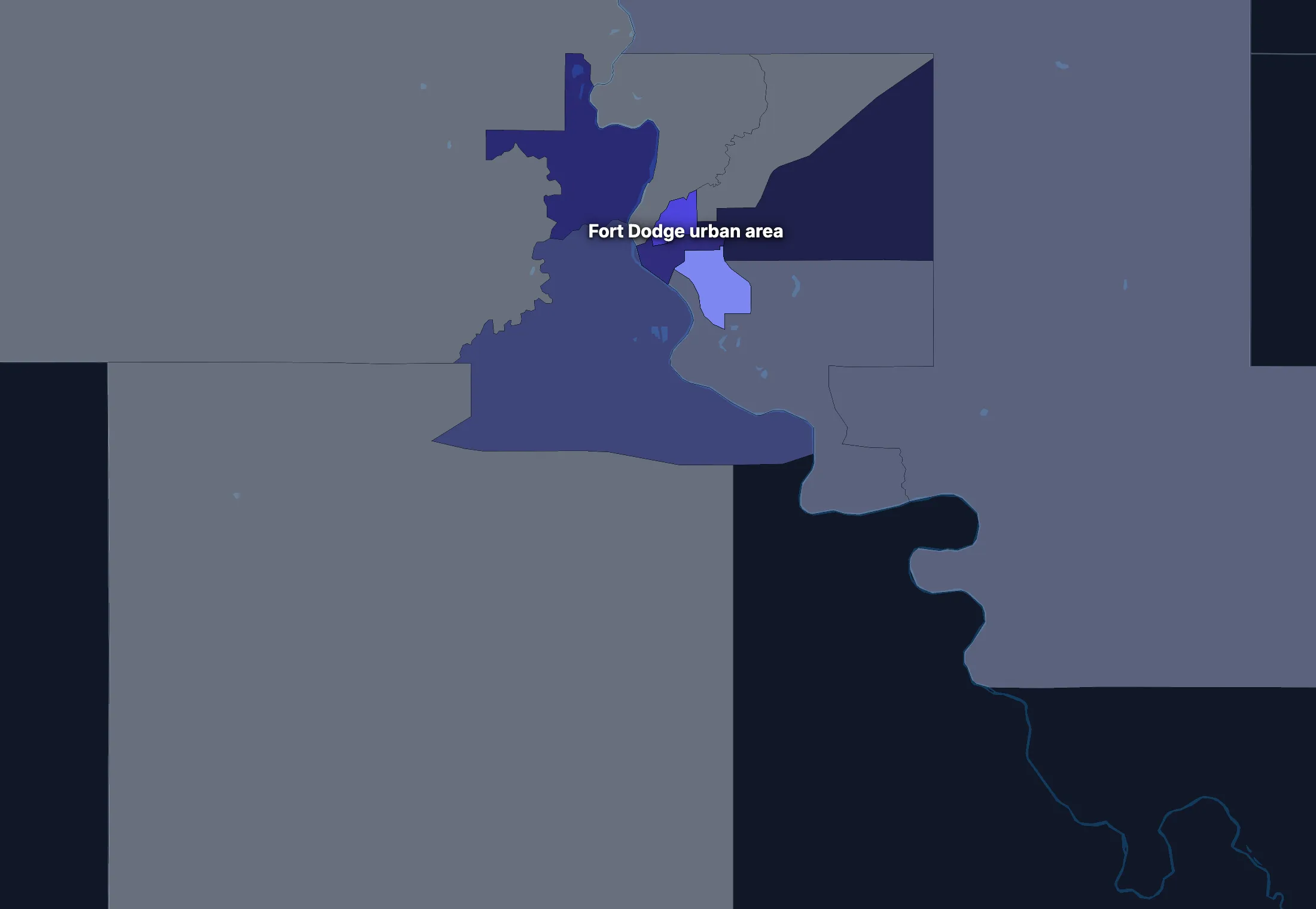
Where the urban area’s average misleads
Each tick is one census tract, and the dark line marks the urban area. Hover over a tick or tap it to see the tract.
Poverty
1 of 3 tracts is at least 1.5 times the urban area’s overall 22.5%, and 0 are at two-thirds of it or less.
Highest: Tract 7, 36.2%.
Renters paying 30% or more of income
0 of 3 tracts are at least 1.5 times the urban area’s overall 41.9%, and 1 is at two-thirds of it or less.
Lowest: Tract 6, 26.5%.
Adults with a bachelor’s degree
1 of 3 tracts is at least 1.5 times the urban area’s overall 15.3%, and 1 is at two-thirds of it or less.
Highest: Tract 4, 23.2%. Lowest: Tract 7, 8.1%.
Median household income
0 of 3 tracts are at least 1.5 times the typical tract’s $53,162, and 1 is at two-thirds of it or less.
Lowest: Tract 7, $30,860.
American Community Survey 2020–2024 5-year estimates, by census tract. Income is capped at $250,000+ by the Census Bureau.
People
Who lives in the Fort Dodge urban area
Its median age of 37.3 is about the same as Iowa (38.6) but lower than the US (38.9). 4.1% of residents were born outside the US, and 6.2% speak a language other than English at home.
Age
Source: ACS 2020–2024 5-year, table A01001.
Show data
| Fort Dodge urban area | Iowa | United States | |
|---|---|---|---|
| Under 18 | 20.8% ±2.0% , number 5,142 ±499 | 22.9% ±0.1% , number 735,015 ±3,402 | 22.0% ±<0.1% , number 73,517,834 ±38,890 |
| 18 to 24 | 13.8% ±1.5% , number 3,419 ±373 | 10.0% ±0.1% , number 321,343 ±3,495 | 9.1% ±<0.1% , number 30,597,362 ±37,780 |
| 25 to 34 | 12.4% ±0.9% , number 3,061 ±216 | 12.5% ±<0.1% , number 399,923 ±1,135 | 13.7% ±<0.1% , number 45,806,540 ±10,200 |
| 35 to 44 | 12.0% ±1.3% , number 2,955 ±333 | 12.6% ±0.1% , number 405,612 ±3,459 | 13.2% ±<0.1% , number 44,237,292 ±43,510 |
| 45 to 54 | 10.6% ±0.9% , number 2,614 ±223 | 11.3% ±<0.1% , number 362,615 ±1,240 | 12.2% ±<0.1% , number 40,743,799 ±8,564 |
| 55 to 64 | 11.9% ±1.2% , number 2,944 ±297 | 12.6% ±0.1% , number 403,843 ±3,325 | 12.7% ±<0.1% , number 42,386,044 ±41,500 |
| 65 to 74 | 10.2% ±1.1% , number 2,530 ±271 | 10.6% ±0.1% , number 339,586 ±3,235 | 10.2% ±<0.1% , number 34,092,907 ±38,800 |
| 75 and over | 8.3% ±1.0% , number 2,050 ±256 | 7.6% ±0.1% , number 242,570 ±2,350 | 7.0% ±<0.1% , number 23,540,721 ±31,560 |
Embed
Race and ethnicity
Source: ACS 2020–2024 5-year, table A04001.
Show data
| Fort Dodge urban area | Iowa | United States | |
|---|---|---|---|
| White, not Hispanic | 79.7% ±1.0% , number 19,707 ±285 | 82.3% ±0.1% , number 2,642,646 ±2,135 | 57.4% ±<0.1% , number 192,214,378 ±30,950 |
| Hispanic or Latino | 9.0% ±0.5% , number 2,214 ±113 | 7.3% ±<0.1% , number 233,706 ±140 | 19.3% ±<0.1% , number 64,759,370 ±1,547 |
| Black, not Hispanic | 4.5% ±0.9% , number 1,123 ±226 | 3.8% ±0.1% , number 121,705 ±2,069 | 11.9% ±<0.1% , number 39,896,127 ±46,710 |
| Asian, not Hispanic | 1.5% ±0.5% , number 364 ±116 | 2.5% ±<0.1% , number 79,174 ±1,418 | 5.9% ±<0.1% , number 19,678,814 ±22,770 |
| Other or multiracial | 5.3% ±1.0% , number 1,307 ±248 | 4.2% ±0.1% , number 133,276 ±3,492 | 5.5% ±<0.1% , number 18,373,810 ±69,180 |
Embed
Language spoken at home
Source: ACS 2020–2024 5-year, table C16001.
Show data
| Fort Dodge urban area | Iowa | United States | |
|---|---|---|---|
| English only | 93.8% ±1.1% , number 21,954 ±325 | 90.9% ±0.2% , number 2,746,525 ±5,059 | 77.7% ±0.1% , number 245,767,039 ±221,000 |
| Spanish | 4.2% ±1.1% , number 979 ±256 | 4.7% ±0.1% , number 140,635 ±2,865 | 13.6% ±<0.1% , number 42,869,908 ±143,800 |
| Other Indo-European | 0.6% ±0.3% , number 150 ±81 | 1.8% ±0.1% , number 55,312 ±2,627 | 3.9% ±<0.1% , number 12,249,474 ±54,760 |
| Asian and Pacific Island | 0.8% ±0.5% , number 192 ±109 | 1.7% ±0.1% , number 52,772 ±2,322 | 3.6% ±<0.1% , number 11,320,253 ±40,030 |
| Arabic and other | 0.6% ±0.4% , number 135 ±97 | 0.9% ±0.1% , number 27,424 ±1,938 | 1.2% ±<0.1% , number 3,935,874 ±33,550 |
Embed
Marital status
Source: ACS 2020–2024 5-year, table A11001.
Show data
| Fort Dodge urban area | Iowa | United States | |
|---|---|---|---|
| Now married | 36.4% ±2.0% , number 7,496 ±440 | 50.8% ±0.2% , number 1,325,601 ±6,352 | 47.8% ±0.1% , number 131,199,078 ±272,700 |
| Never married | 42.6% ±2.1% , number 8,767 ±458 | 31.8% ±0.2% , number 828,666 ±4,614 | 34.4% ±0.1% , number 94,480,845 ±211,900 |
| Divorced | 12.5% ±1.4% , number 2,565 ±291 | 10.5% ±0.1% , number 273,732 ±3,614 | 10.6% ±<0.1% , number 29,074,059 ±73,390 |
| Widowed | 7.6% ±1.1% , number 1,570 ±220 | 5.8% ±0.1% , number 151,294 ±2,039 | 5.6% ±<0.1% , number 15,250,943 ±26,710 |
| Separated | 0.9% ±0.5% , number 195 ±96 | 1.1% ±0.1% , number 28,528 ±1,438 | 1.7% ±<0.1% , number 4,592,038 ±29,170 |
Embed
Where people lived a year ago
Source: ACS 2020–2024 5-year, table A08001.
Show data
| Fort Dodge urban area | Iowa | United States | |
|---|---|---|---|
| Same home | 81.4% ±2.9% , number 19,902 ±719 | 87.1% ±0.2% , number 2,766,249 ±7,326 | 87.7% ±0.1% , number 290,692,803 ±173,800 |
| Same county | 7.8% ±2.0% , number 1,910 ±490 | 6.7% ±0.2% , number 211,478 ±5,998 | 6.3% ±<0.1% , number 20,792,831 ±117,600 |
| Another county in the state | 7.1% ±1.4% , number 1,747 ±337 | 3.7% ±0.1% , number 115,891 ±3,906 | 3.1% ±<0.1% , number 10,316,864 ±51,200 |
| Another state | 3.2% ±0.9% , number 781 ±221 | 2.2% ±0.1% , number 69,786 ±3,072 | 2.3% ±<0.1% , number 7,577,400 ±40,570 |
| Another country | 0.5% ±0.3% , number 113 ±80 | 0.4% ±<0.1% , number 11,678 ±1,214 | 0.6% ±<0.1% , number 2,060,087 ±23,560 |
Embed
Top countries of birth, among those born abroad
Source: ACS 2020–2024 5-year, table A07001.
Show data
| Fort Dodge urban area | |
|---|---|
| Mexico | 29.6% , number 297 |
| Korea | 17.8% , number 179 |
| Guatemala | 14.4% , number 145 |
| China, Excluding Hong Kong and Taiwan | 10.8% , number 108 |
| Kenya | 6.0% , number 60 |
| Dominican Republic | 4.4% , number 44 |
Embed
All the numbers
| Indicator | Fort Dodge urban area | Iowa | US | Rank in Iowa* | Table |
|---|---|---|---|---|---|
| Population | 24,715 ±152 | 3,210,507 | 334,922,499 | 14th | A00001 |
| People per square mile | n/a | 57 | 95 | – | A00002 |
| Land area (square miles) | n/a | – | – | – | A00002 |
| Median age | 37.3 ±1.5 | 38.6 ±0.2 | 38.9 ±0.1 | 50th | A01004 |
| Under 18 | 20.8% ±2.0% , number 5,142 ±499 | 22.9% ±0.1% , number 735,015 ±3,402 | 22.0% ±<0.1% , number 73,517,834 ±38,890 | 44th | B02002 |
| 65 and over | 18.5% ±1.5% , number 4,580 ±373 | 18.1% ±0.1% , number 582,156 ±3,999 | 17.2% ±<0.1% , number 57,633,628 ±50,010 | 44th | B02002 |
| Born outside the US | 4.1% ±1.2% , number 1,004 ±292 | 5.9% ±0.1% , number 189,988 ±3,624 | 14.1% ±<0.1% , number 47,349,078 ±143,600 | 30th | A06001 |
| Speak a language other than English at home | 6.2% ±1.1% , number 1,456 ±306 | 9.1% ±0.2% , number 276,143 ±4,925 | 22.3% ±0.1% , number 70,375,509 ±162,500 | 34th | C16001 |
| Veterans (adults) | 5.3% ±1.2% , number 1,043 ±237 | 6.5% ±0.1% , number 160,571 ±2,289 | 6.2% ±<0.1% , number 16,185,883 ±45,250 | 54th | A16002 |
| Living with a disability | 14.9% ±1.8% , number 3,418 ±403 | 12.6% ±0.1% , number 400,232 ±4,123 | 13.3% ±<0.1% , number 43,869,797 ±68,920 | 33rd | B18101 |
| Women 15–50 who had a baby in the past year | 5.1% ±2.2% , number 266 ±115 | 5.7% ±0.2% , number 41,080 ±1,625 | 5.1% ±<0.1% , number 4,009,203 ±20,900 | 39th | B13002 |
| Lived in the same home a year ago | 81.4% ±2.9% , number 19,902 ±719 | 87.1% ±0.2% , number 2,766,249 ±7,326 | 87.7% ±0.1% , number 290,692,803 ±173,800 | 57th | A08001 |
| White, not Hispanic | 79.7% ±1.0% , number 19,707 ±285 | 82.3% ±0.1% , number 2,642,646 ±2,135 | 57.4% ±<0.1% , number 192,214,378 ±30,950 | 51st | A04001 |
| Hispanic or Latino | 9.0% ±0.5% , number 2,214 ±113 | 7.3% ±<0.1% , number 233,706 ±140 | 19.3% ±<0.1% , number 64,759,370 ±1,547 | 22nd | A04001 |
| Black, not Hispanic | 4.5% ±0.9% , number 1,123 ±226 | 3.8% ±0.1% , number 121,705 ±2,069 | 11.9% ±<0.1% , number 39,896,127 ±46,710 | 11th | A04001 |
| Asian, not Hispanic | 1.5% ±0.5% , number 364 ±116 | 2.5% ±<0.1% , number 79,174 ±1,418 | 5.9% ±<0.1% , number 19,678,814 ±22,770 | 24th | A04001 |
*1 is the highest. Population is ranked among all urban areas, and the rest among those of 1,000 people or more, whose figures can be ranked. Ranks use 5-year estimates, the only ones covering every urban area, so they can differ slightly from the figures here.
Income and work
Lower incomes than the US
The median household income is $60,318, lower than both Iowa ($75,059) and the US ($80,734). 15.8% of people live in poverty, and 7.2% have no health insurance, higher than Iowa (5.0%) but about the same as the US (8.4%).
Household income
Source: ACS 2020–2024 5-year, table A14001.
Show data
| Fort Dodge urban area | Iowa | United States | |
|---|---|---|---|
| Under $25,000 | 19.2% ±3.0% , number 1,961 ±312 | 13.9% ±0.2% , number 183,263 ±3,073 | 14.6% ±<0.1% , number 18,908,588 ±41,540 |
| $25,000 to $49,999 | 24.4% ±3.6% , number 2,502 ±374 | 18.5% ±0.3% , number 243,713 ±3,617 | 16.7% ±<0.1% , number 21,624,902 ±39,130 |
| $50,000 to $74,999 | 16.6% ±2.5% , number 1,701 ±263 | 17.5% ±0.3% , number 230,392 ±3,683 | 15.5% ±<0.1% , number 20,031,683 ±36,850 |
| $75,000 to $99,999 | 14.5% ±2.4% , number 1,487 ±252 | 14.0% ±0.3% , number 184,128 ±3,338 | 12.6% ±<0.1% , number 16,319,799 ±42,700 |
| $100,000 to $149,999 | 14.0% ±2.6% , number 1,431 ±270 | 18.7% ±0.3% , number 245,953 ±3,463 | 17.5% ±<0.1% , number 22,670,921 ±58,280 |
| $150,000 to $199,999 | 8.1% ±2.0% , number 829 ±210 | 8.8% ±0.2% , number 115,618 ±2,181 | 9.6% ±<0.1% , number 12,405,370 ±57,560 |
| $200,000 or more | 3.2% ±1.0% , number 323 ±106 | 8.6% ±0.2% , number 112,640 ±2,007 | 13.4% ±0.1% , number 17,266,233 ±82,370 |
Embed
What residents do for work
Source: ACS 2020–2024 5-year, table A17004.
Show data
| Fort Dodge urban area | Iowa | United States | |
|---|---|---|---|
| Education and health care | 25.8% ±2.6% , number 3,029 ±340 | 24.2% ±0.3% , number 396,455 ±4,865 | 23.5% ±0.1% , number 37,913,663 ±133,200 |
| Manufacturing | 16.4% ±2.0% , number 1,918 ±256 | 14.7% ±0.2% , number 241,106 ±3,350 | 9.9% ±<0.1% , number 15,940,000 ±38,890 |
| Retail trade | 12.3% ±2.3% , number 1,444 ±273 | 11.5% ±0.2% , number 188,629 ±2,910 | 10.8% ±<0.1% , number 17,456,908 ±41,100 |
| Arts, food and lodging | 10.7% ±2.1% , number 1,255 ±257 | 7.0% ±0.2% , number 113,941 ±2,770 | 8.7% ±<0.1% , number 13,952,453 ±52,980 |
| Construction | 8.1% ±2.1% , number 950 ±255 | 6.9% ±0.2% , number 113,871 ±2,546 | 6.9% ±<0.1% , number 11,167,040 ±57,000 |
| Professional and business services | 5.3% ±1.4% , number 619 ±164 | 7.6% ±0.2% , number 124,829 ±2,597 | 12.6% ±<0.1% , number 20,282,450 ±59,650 |
| Finance, insurance and real estate | 4.4% ±1.5% , number 519 ±172 | 7.6% ±0.1% , number 124,916 ±2,440 | 6.7% ±<0.1% , number 10,783,159 ±41,000 |
| Transportation and warehousing | 4.1% ±1.1% , number 485 ±132 | 5.1% ±0.1% , number 83,794 ±2,207 | 5.9% ±<0.1% , number 9,568,767 ±29,300 |
Embed
All the numbers
| Indicator | Fort Dodge urban area | Iowa | US | Rank in Iowa* | Table |
|---|---|---|---|---|---|
| Median household income | $60,318 ±$6,998 | $75,059 ±$418 | $80,734 ±$166 | 48th | A14006 |
| Income per person | $33,602 ±$2,420 | $40,877 ±$247 | $44,673 ±$122 | 52nd | A14024 |
| Income inequality (Gini index) | 0.452 ±0.036 | 0.444 ±0.003 | 0.483 | 23rd | A14028 |
| Living in poverty | 15.8% ±2.6% , number 3,480 ±574 | 11.1% ±0.2% , number 344,519 ±6,799 | 12.5% ±0.1% , number 40,735,661 ±275,900 | 21st | A13004 |
| Unemployment rate | 5.8% ±1.5% , number 724 ±186 | 3.6% ±0.1% , number 60,853 ±2,356 | 5.2% ±<0.1% , number 8,902,365 ±38,980 | 14th | A17005 |
| No health insurance | 7.2% ±1.3% , number 1,655 ±309 | 5.0% ±0.1% , number 158,299 ±3,538 | 8.4% ±<0.1% , number 27,734,911 ±158,900 | 9th | A20001 |
*1 is the highest. Population is ranked among all urban areas, and the rest among those of 1,000 people or more, whose figures can be ranked. Ranks use 5-year estimates, the only ones covering every urban area, so they can differ slightly from the figures here.
Education
Fewer college degrees than the US
21.4% of adults 25 and over have a bachelor’s degree or more, lower than both Iowa (31.4%) and the US (35.7%).
Highest level of education
Source: ACS 2020–2024 5-year, table A12001.
Show data
| Fort Dodge urban area | Iowa | United States | |
|---|---|---|---|
| Less than high school | 8.3% ±1.7% , number 1,333 ±271 | 6.7% ±0.1% , number 145,298 ±2,968 | 10.4% ±<0.1% , number 23,992,410 ±82,490 |
| High school only | 32.9% ±2.6% , number 5,307 ±436 | 30.0% ±0.3% , number 646,234 ±5,968 | 26.0% ±0.1% , number 60,094,716 ±262,500 |
| Some college | 37.5% ±3.0% , number 6,065 ±496 | 31.8% ±0.3% , number 685,709 ±5,520 | 27.9% ±0.1% , number 64,356,961 ±143,900 |
| Bachelor’s degree | 15.9% ±2.1% , number 2,564 ±344 | 20.9% ±0.2% , number 450,118 ±5,026 | 21.6% ±0.1% , number 49,868,171 ±191,400 |
| Graduate degree | 5.5% ±1.2% , number 885 ±196 | 10.5% ±0.2% , number 226,790 ±3,481 | 14.1% ±0.1% , number 32,495,045 ±159,600 |
Embed
All the numbers
| Indicator | Fort Dodge urban area | Iowa | US | Rank in Iowa* | Table |
|---|---|---|---|---|---|
| Bachelor’s degree or more | 21.4% ±2.4% , number 3,449 ±396 | 31.4% ±0.3% , number 676,908 ±6,114 | 35.7% ±0.1% , number 82,363,216 ±249,200 | 45th | A12001 |
| High school graduate or more | 91.7% ±4.4% , number 14,821 ±770 | 93.3% ±0.5% , number 2,008,851 ±10,170 | 89.6% ±0.2% , number 206,814,893 ±389,500 | 48th | A12001 |
*1 is the highest. Population is ranked among all urban areas, and the rest among those of 1,000 people or more, whose figures can be ranked. Ranks use 5-year estimates, the only ones covering every urban area, so they can differ slightly from the figures here.
Housing
Homes and what they cost
35.5% of households rent, higher than Iowa (28.3%) but about the same as the US (34.8%). The median home is worth $141,200 and the median rent is $789.
Types of homes
Source: ACS 2020–2024 5-year, table A10032.
Show data
| Fort Dodge urban area | Iowa | United States | |
|---|---|---|---|
| Single-family, detached | 68.4% ±3.3% , number 7,836 ±404 | 72.2% ±0.2% , number 1,038,172 ±3,561 | 61.3% ±0.1% , number 88,075,458 ±149,800 |
| Single-family, attached | 2.8% ±0.8% , number 319 ±91 | 4.5% ±0.1% , number 64,736 ±1,918 | 6.2% ±<0.1% , number 8,955,086 ±33,580 |
| 2 to 4 units | 12.5% ±2.8% , number 1,436 ±323 | 5.6% ±0.2% , number 80,180 ±2,234 | 7.7% ±<0.1% , number 11,031,346 ±42,810 |
| 5 to 19 units | 6.0% ±1.8% , number 685 ±205 | 7.5% ±0.2% , number 108,386 ±2,509 | 8.8% ±<0.1% , number 12,625,154 ±51,990 |
| 20 or more units | 7.8% ±1.6% , number 898 ±188 | 6.9% ±0.2% , number 99,608 ±2,210 | 10.3% ±<0.1% , number 14,859,547 ±31,000 |
| Mobile homes and other | 2.5% ±0.8% , number 281 ±97 | 3.2% ±0.1% , number 46,617 ±1,660 | 5.7% ±<0.1% , number 8,228,764 ±48,580 |
Embed
When homes were built
Source: ACS 2020–2024 5-year, table A10055.
Show data
| Fort Dodge urban area | Iowa | United States | |
|---|---|---|---|
| 2010 or later | 4.9% ±1.7% , number 504 ±177 | 11.1% ±0.2% , number 146,416 ±2,723 | 11.6% ±<0.1% , number 14,996,534 ±51,640 |
| 2000 to 2009 | 5.5% ±1.5% , number 565 ±153 | 11.1% ±0.2% , number 145,699 ±2,423 | 13.8% ±<0.1% , number 17,865,859 ±70,250 |
| 1980 to 1999 | 11.8% ±2.5% , number 1,208 ±259 | 17.0% ±0.2% , number 223,032 ±3,332 | 25.3% ±<0.1% , number 32,758,140 ±75,080 |
| 1960 to 1979 | 22.5% ±2.9% , number 2,307 ±312 | 23.9% ±0.3% , number 315,053 ±3,835 | 23.9% ±<0.1% , number 30,938,809 ±78,560 |
| Before 1960 | 55.2% ±5.0% , number 5,650 ±546 | 36.9% ±0.3% , number 485,507 ±4,542 | 25.3% ±<0.1% , number 32,668,154 ±83,060 |
Embed
All the numbers
| Indicator | Fort Dodge urban area | Iowa | US | Rank in Iowa* | Table |
|---|---|---|---|---|---|
| Housing units | 11,455 ±194 | – | – | – | A10001 |
| Households | 10,234 ±363 | – | – | – | A10008 |
| People per household | 2.15 ±0.07 | 2.36 ±0.01 | 2.53 ±0.01 | 46th | A10003 |
| Households that rent | 35.5% ±4.2% , number 3,631 ±444 | 28.3% ±0.3% , number 372,311 ±3,635 | 34.8% ±0.1% , number 45,017,354 ±163,600 | 24th | A10060 |
| Vacant homes | 10.7% ±2.7% , number 1,221 ±307 | 8.5% ±0.3% , number 121,992 ±3,789 | 10.1% ±0.1% , number 14,547,859 ±200,400 | 20th | A10047, A10060 |
| Median gross rent | $789 ±$35 | $972 ±$6 | $1,413 ±$2 | 53rd | A18009 |
| Median home value | $141,200 ±$11,760 | $208,000 ±$1,141 | $332,700 ±$236 | 48th | A10036 |
| Renters paying 30% or more of income | 41.9% ±6.1% , number 1,523 ±288 | 40.5% ±0.8% , number 150,913 ±3,242 | 47.6% ±0.2% , number 21,422,415 ±63,960 | 34th | A18002 |
| Owners paying 30% or more of income | 16.4% ±3.2% , number 1,081 ±222 | 17.0% ±0.3% , number 160,672 ±2,562 | 22.5% ±0.1% , number 18,961,895 ±39,930 | 39th | A10040 |
| Homes built before 1960 | 55.2% ±5.0% , number 5,650 ±546 | 36.9% ±0.3% , number 485,507 ±4,542 | 25.3% ±<0.1% , number 32,668,154 ±83,060 | 13th | A10055 |
*1 is the highest. Population is ranked among all urban areas, and the rest among those of 1,000 people or more, whose figures can be ranked. Ranks use 5-year estimates, the only ones covering every urban area, so they can differ slightly from the figures here.
Getting around
A driving urban area with short commutes
80.3% of workers drive alone and 4.4% work from home. 15.6% of those who travel to work spend 30 minutes or more getting there, and 8.9% of households have no vehicle.
How people get to work
Source: ACS 2020–2024 5-year, table A09005.
Show data
| Fort Dodge urban area | Iowa | United States | |
|---|---|---|---|
| Drive alone | 80.3% ±3.9% , number 9,264 ±648 | 76.0% ±0.2% , number 1,224,151 ±5,364 | 68.8% ±0.1% , number 109,447,738 ±95,800 |
| Carpool | 8.8% ±2.2% , number 1,015 ±259 | 7.8% ±0.2% , number 125,139 ±2,843 | 8.5% ±<0.1% , number 13,569,614 ±52,500 |
| Public transit | 2.3% ±1.9% , number 263 ±219 | 0.8% ±0.1% , number 13,625 ±990 | 3.5% ±<0.1% , number 5,573,279 ±22,170 |
| Walk | 2.4% ±1.4% , number 274 ±166 | 2.9% ±0.1% , number 46,647 ±1,640 | 2.4% ±<0.1% , number 3,772,609 ±17,080 |
| Work from home | 4.4% ±1.3% , number 508 ±150 | 11.3% ±0.2% , number 182,141 ±2,728 | 15.1% ±<0.1% , number 24,042,489 ±82,860 |
| Other | 1.8% ±1.0% , number 206 ±119 | 1.2% ±0.1% , number 19,692 ±929 | 1.7% ±<0.1% , number 2,708,365 ±17,940 |
Embed
Time spent getting to work
Source: ACS 2020–2024 5-year, table B09001.
Show data
| Fort Dodge urban area | Iowa | United States | |
|---|---|---|---|
| Under 10 minutes | 32.5% ±3.3% , number 3,579 ±415 | 24.0% ±0.3% , number 343,170 ±3,917 | 12.7% ±<0.1% , number 17,153,542 ±40,730 |
| 10 to 19 minutes | 40.8% ±4.3% , number 4,497 ±535 | 34.5% ±0.3% , number 492,424 ±5,214 | 28.7% ±<0.1% , number 38,741,521 ±54,980 |
| 20 to 29 minutes | 11.1% ±2.6% , number 1,224 ±292 | 20.2% ±0.3% , number 288,285 ±4,164 | 21.3% ±<0.1% , number 28,723,420 ±52,330 |
| 30 to 39 minutes | 5.0% ±2.0% , number 553 ±218 | 10.9% ±0.2% , number 156,264 ±2,813 | 16.9% ±<0.1% , number 22,853,044 ±46,230 |
| 40 to 59 minutes | 4.0% ±1.5% , number 443 ±172 | 6.3% ±0.2% , number 90,078 ±2,456 | 11.9% ±<0.1% , number 16,024,037 ±44,090 |
| 60 minutes or more | 6.6% ±2.5% , number 726 ±280 | 4.1% ±0.1% , number 59,033 ±1,693 | 8.6% ±<0.1% , number 11,576,041 ±36,550 |
Embed
Vehicles per household
Source: ACS 2020–2024 5-year, table A10030.
Show data
| Fort Dodge urban area | Iowa | United States | |
|---|---|---|---|
| None | 8.9% ±2.1% , number 911 ±221 | 5.4% ±0.1% , number 71,676 ±1,957 | 8.4% ±<0.1% , number 10,793,323 ±36,450 |
| One | 41.2% ±4.2% , number 4,213 ±457 | 30.5% ±0.3% , number 401,125 ±4,322 | 33.1% ±0.1% , number 42,801,892 ±122,600 |
| Two | 32.2% ±3.2% , number 3,292 ±347 | 37.8% ±0.4% , number 497,251 ±5,483 | 36.6% ±0.1% , number 47,334,152 ±191,100 |
| Three or more | 17.8% ±2.9% , number 1,818 ±303 | 26.3% ±0.3% , number 345,655 ±3,805 | 21.9% ±0.1% , number 28,298,129 ±85,940 |
Embed
All the numbers
| Indicator | Fort Dodge urban area | Iowa | US | Rank in Iowa* | Table |
|---|---|---|---|---|---|
| Drive to work alone | 80.3% ±3.9% , number 9,264 ±648 | 76.0% ±0.2% , number 1,224,151 ±5,364 | 68.8% ±0.1% , number 109,447,738 ±95,800 | 17th | A09005 |
| Take public transit | 2.3%† (too uncertain to lean on) ±1.9% , number 263 ±219 | 0.8% ±0.1% , number 13,625 ±990 | 3.5% ±<0.1% , number 5,573,279 ±22,170 | 5th | A09005 |
| Work from home | 4.4% ±1.3% , number 508 ±150 | 11.3% ±0.2% , number 182,141 ±2,728 | 15.1% ±<0.1% , number 24,042,489 ±82,860 | 58th | A09005 |
| Commute 30 minutes or more | 15.6% ±3.5% , number 1,722 ±395 | 21.4% ±0.3% , number 305,375 ±4,100 | 37.4% ±<0.1% , number 50,453,122 ±73,600 | 44th | B09001 |
| Households with no vehicle | 8.9% ±2.2% , number 911 ±228 | 5.4% ±0.1% , number 71,676 ±1,876 | 8.4% ±<0.1% , number 10,793,323 ±27,220 | 13th | A10030 |
*1 is the highest. Population is ranked among all urban areas, and the rest among those of 1,000 people or more, whose figures can be ranked. Ranks use 5-year estimates, the only ones covering every urban area, so they can differ slightly from the figures here.
Places
In and around the Fort Dodge urban area
Population, from the latest estimates available. Figures cover the whole of each place.
Places nearby
- Fort Dodge: 24,827
- Webster City: 7,769
- Humboldt: 4,771
- Eagle Grove: 3,593
- Rockwell City: 2,401
- Manson: 1,645
- Gowrie: 932
- Dakota City: 752
Its county
- Webster County: 36,886
Urban areas like this one
- Anniston–Oxford, AL Urban Area: 77,711
- St. Joseph, MO–KS Urban Area: 75,724
- Ponca City, OK Urban Area: 24,826
- Mount Pleasant, IA Urban Area: 8,669
Urban areas at least a third this size, with the closest income, education, age, housing and origins.
Turn the Fort Dodge urban area into your planning report.
Social Explorer Studio builds an editable profile of any place, with tables and charts beside the county and state, and exports to Word, PDF and Excel.
Questions about the Fort Dodge urban area
What is the population of Fort Dodge, IA Urban Area?
24,715 people (±152), according to the ACS 2020–2024 5-year estimates. That’s the 14th largest of 69 urban areas in Iowa.
What is an urban area?
A densely settled area drawn by the Census Bureau from census blocks after each census, with at least 2,000 homes or 5,000 people, whatever the city lines. The Fort Dodge urban area, code 30682, is one of its 2020 urban areas.
What county is the Fort Dodge urban area in?
The Fort Dodge urban area is in Webster County.
What is the median household income in the Fort Dodge urban area?
$60,318 (±$6,998), according to the ACS 2020–2024 5-year estimates, lower than both Iowa ($75,059) and the US ($80,734).
What is the median age in the Fort Dodge urban area?
37.3 years (±1.5), according to the ACS 2020–2024 5-year estimates, about the same as Iowa (38.6) but lower than the US (38.9).
How much does housing cost in the Fort Dodge urban area?
The Fort Dodge urban area’s median home value is $141,200 (±$11,760) and its median gross rent is $789 (±$35) a month, according to the ACS 2020–2024 5-year estimates. 41.9% (±6.1%) of its renters pay 30% or more of their income on rent.
Where does this census data come from?
The U.S. Census Bureau’s American Community Survey, through Social Explorer’s tables: the latest 1-year estimates where they exist, for the most recent numbers, and 5-year estimates otherwise. Each table lists its code, so you can find it again.
Is this data free to use?
Yes. You can read it, cite it, download the CSV and embed the charts, with no account. To map other variables, compare your own areas or build a report, see Social Explorer’s plans in a live demo.
Sources and how to cite
American Community Survey 2020–2024 5-year estimates, U.S. Census Bureau, from Social Explorer’s tables A00001, A00002, A01004, A04001, A06001, A08001, A09005, A10001, A10003, A10008, A10030, A10036, A10040, A10047, A10055, A10060, A12001, A13004, A14006, A14024, A14028, A16002, A17005, A18002, A18009, A20001, B02002, B09001, B13002, B18101, C16001. Maps by census tract use 2020–2024 5-year estimates, since the 1-year survey doesn’t cover tracts. These are estimates from a sample, each with its margin of error. Data retrieved November 14, 2026. How these profiles are made.
U.S. Census Bureau, American Community Survey 2020–2024 5-year estimates, via Social Explorer. “Fort Dodge, IA Urban Area.” https://www.socialexplorer.com/places/urban/fort-dodge-ia-urban-area. Accessed November 14, 2026.