

Fort Payne, Alabama · population, demographics and census data
Home to 14,927 people, the 49th largest of Alabama’s 592 places. It grew 5.8% between 2010–2014 and 2020–2024.
- Population
- 14,927 ±43. Rank 49 of 592 in Alabama
- Median household income
- $47,479 ±$7,304. Alabama $63,999 · US $80,734
- Median age
- 37.4 ±3.1. Alabama 39.3 · US 38.9
ACS 2020–2024 5-year estimates, U.S. Census Bureau
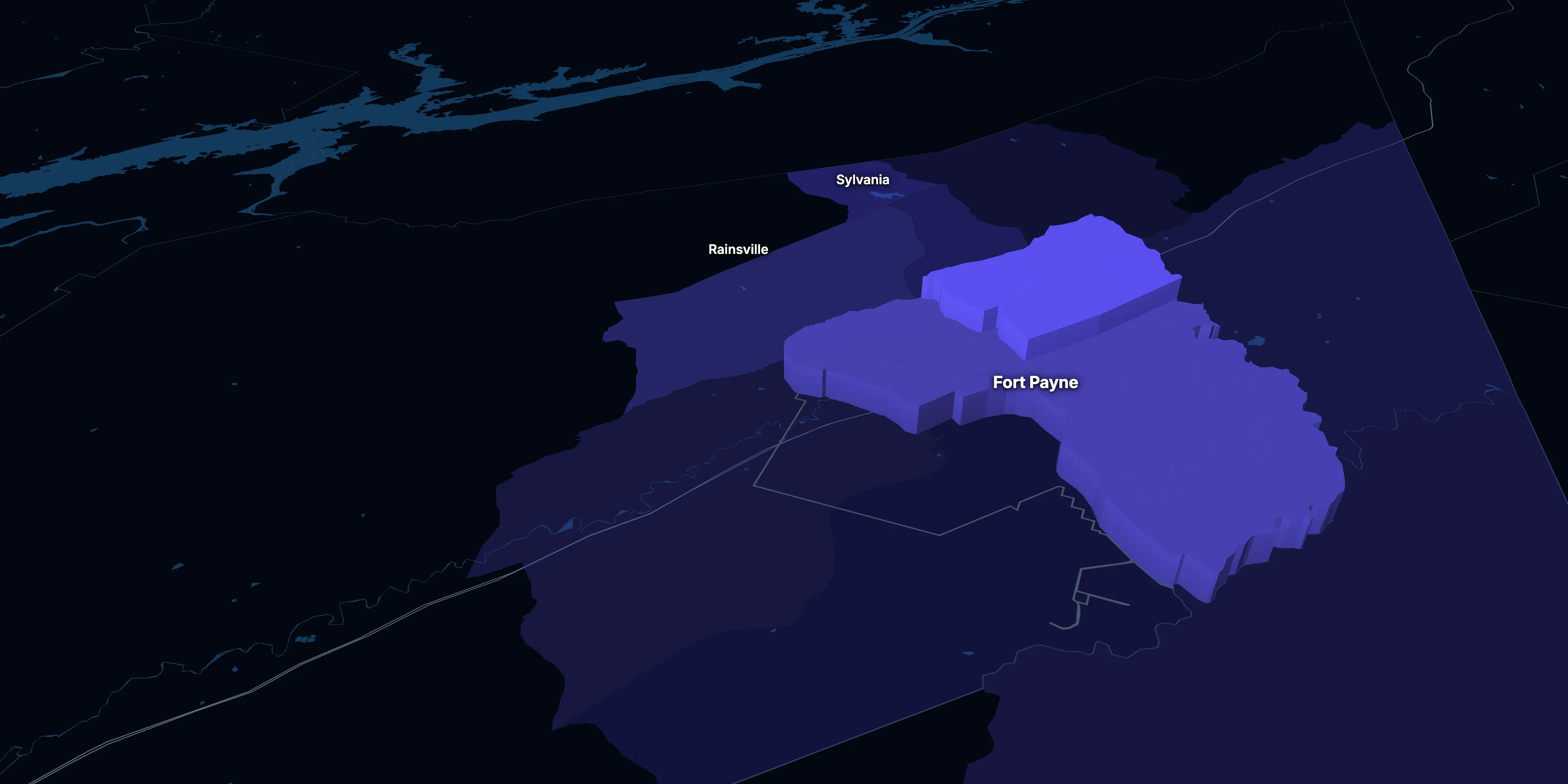
Taller, lighter tracts have higher household incomes
About Fort Payne
Fort Payne’s median household income is $47,479 (±$7,304), lower than both Alabama ($63,999) and the US ($80,734), and its median age is 37.4 (±3.1), according to the ACS 2020–2024 5-year estimates.
± is each figure’s margin of error, at 90% confidence, and † marks one too uncertain to lean on. Under each percentage in the tables is the number it counts. How the margins are worked out.
FIPS code 0127616
Highlights
What stands out in Fort Payne
The numbers where Fort Payne sits furthest from Alabama and the nation, or past a recognized policy benchmark.
Past a policy benchmark
32.5%
Very highLiving in poverty
That’s higher than both Alabama (15.6%) and the US (12.5%). HUD and the New Markets Tax Credit use 20% poverty to mark low-income areas. It’s the 30th highest of 320 Alabama places.
Furthest from the national picture
$679
Very lowMedian gross rent
That’s lower than both Alabama ($1,007) and the US ($1,413).
0.0%
Very lowTake public transit
That’s about the same as Alabama (0.4%) but lower than the US (3.5%).
0.2%
Very lowAsian, not Hispanic
That’s lower than both Alabama (1.4%) and the US (5.9%).
17.3%
Very lowBachelor’s degree or more
That’s lower than both Alabama (28.4%) and the US (35.7%).
17.8%
Very lowCommute 30 minutes or more
That’s lower than both Alabama (35.6%) and the US (37.4%). It’s the 12th lowest of 320 Alabama places.
2010–2014 to 2020–2024
How Fort Payne changed in ten years
The city added 812 people. It got younger, less foreign-born and better educated, and poverty rose 8.7 points.
Population, change since 2010–14
+5.8% in the city, +5.6% in Alabama and +6.6% in the US.
Source: ACS 5-year, 2010–14 to 2020–24, table A00001.
Show data
| Fort Payne | Alabama | United States | |
|---|---|---|---|
| 2010–14 | 0.0% | 0.0% | 0.0% |
| 2011–15 | −0.0% | +0.3% | +0.8% |
| 2012–16 | −0.1% | +0.5% | +1.4% |
| 2013–17 | −0.7% | +0.7% | +2.2% |
| 2014–18 | −0.8% | +1.0% | +2.8% |
| 2015–19 | 0.0% | +1.2% | +3.4% |
| 2016–20 | −0.4% | +1.6% | +4.0% |
| 2017–21 | +4.4% | +3.7% | +5.0% |
| 2018–22 | +5.0% | +4.4% | +5.4% |
| 2019–23 | +5.5% | +4.9% | +5.8% |
| 2020–24 | +5.8% | +5.6% | +6.6% |
Embed
Median household income, in 2024 dollars
+3.1% in the city, +10.8% in Alabama and +13.7% in the US.
Source: ACS 5-year, 2010–14 to 2020–24, table A14006.
Show data
| Fort Payne | Alabama | United States | |
|---|---|---|---|
| 2010–14 | $46,063 | $57,777 | $71,018 |
| 2011–15 | $51,477 | $57,826 | $71,435 |
| 2012–16 | $50,314 | $58,575 | $72,401 |
| 2013–17 | $52,938 | $59,538 | $73,862 |
| 2014–18 | $50,505 | $60,640 | $75,407 |
| 2015–19 | $49,472 | $62,079 | $77,198 |
| 2016–20 | $51,200 | $63,133 | $78,856 |
| 2017–21 | $51,385 | $63,687 | $80,006 |
| 2018–22 | $47,750 | $63,891 | $80,548 |
| 2019–23 | $50,051 | $63,849 | $80,845 |
| 2020–24 | $47,479 | $63,999 | $80,734 |
Embed
Living in poverty
+8.7 points in the city, −3.3 points in Alabama and −3.1 points in the US.
Source: ACS 5-year, 2010–14 to 2020–24, table A13004.
Show data
| Fort Payne | Alabama | United States | |
|---|---|---|---|
| 2010–14 | 23.8% | 18.9% | 15.6% |
| 2011–15 | 19.0% | 18.8% | 15.5% |
| 2012–16 | 21.9% | 18.4% | 15.1% |
| 2013–17 | 21.7% | 18.0% | 14.6% |
| 2014–18 | 23.3% | 17.5% | 14.1% |
| 2015–19 | 24.1% | 16.7% | 13.4% |
| 2016–20 | 24.6% | 16.0% | 12.8% |
| 2017–21 | 22.5% | 15.8% | 12.6% |
| 2018–22 | 23.6% | 15.7% | 12.5% |
| 2019–23 | 23.5% | 15.6% | 12.4% |
| 2020–24 | 32.5% | 15.6% | 12.5% |
Embed
Bachelor’s degree or more
+4.6 points in the city, +5.3 points in Alabama and +6.4 points in the US.
Source: ACS 5-year, 2010–14 to 2020–24, table A12001.
Show data
| Fort Payne | Alabama | United States | |
|---|---|---|---|
| 2010–14 | 12.7% | 23.1% | 29.3% |
| 2011–15 | 13.0% | 23.5% | 29.8% |
| 2012–16 | 12.5% | 24.0% | 30.3% |
| 2013–17 | 14.6% | 24.5% | 30.9% |
| 2014–18 | 15.7% | 24.9% | 31.5% |
| 2015–19 | 17.1% | 25.5% | 32.1% |
| 2016–20 | 17.5% | 26.2% | 32.9% |
| 2017–21 | 18.6% | 26.7% | 33.7% |
| 2018–22 | 18.1% | 27.2% | 34.3% |
| 2019–23 | 17.5% | 27.8% | 35.0% |
| 2020–24 | 17.3% | 28.4% | 35.7% |
Embed
Median gross rent, in 2024 dollars
−4.2% in the city, +6.1% in Alabama and +15.6% in the US.
Source: ACS 5-year, 2010–14 to 2020–24, table A18009.
Show data
| Fort Payne | Alabama | United States | |
|---|---|---|---|
| 2010–14 | $709 | $949 | $1,222 |
| 2011–15 | $734 | $950 | $1,230 |
| 2012–16 | $741 | $953 | $1,242 |
| 2013–17 | $756 | $957 | $1,258 |
| 2014–18 | $745 | $966 | $1,279 |
| 2015–19 | $731 | $973 | $1,305 |
| 2016–20 | $718 | $984 | $1,330 |
| 2017–21 | $726 | $988 | $1,348 |
| 2018–22 | $713 | $991 | $1,359 |
| 2019–23 | $690 | $991 | $1,388 |
| 2020–24 | $679 | $1,007 | $1,413 |
Embed
Median home value, in 2024 dollars
+22.1% in the city, +27.7% in Alabama and +42.6% in the US.
Source: ACS 5-year, 2010–14 to 2020–24, table A10036.
Show data
| Fort Payne | Alabama | United States | |
|---|---|---|---|
| 2010–14 | $128,539 | $164,391 | $233,308 |
| 2011–15 | $143,429 | $166,362 | $236,751 |
| 2012–16 | $151,287 | $168,170 | $241,720 |
| 2013–17 | $161,555 | $169,242 | $247,905 |
| 2014–18 | $149,331 | $171,593 | $256,264 |
| 2015–19 | $153,430 | $175,295 | $267,181 |
| 2016–20 | $158,211 | $181,506 | $278,810 |
| 2017–21 | $156,137 | $182,102 | $283,875 |
| 2018–22 | $156,060 | $192,289 | $302,152 |
| 2019–23 | $162,745 | $200,832 | $312,314 |
| 2020–24 | $157,000 | $209,900 | $332,700 |
Embed
ACS 5-year estimates. Each point is the five years ending then, and neighboring points share years. Dollar values are in 2024 dollars. Cities and towns annex land, so part of a change can be a new boundary rather than new people.
| Indicator | 2010–2014 | 2020–2024 | Change | Alabama’s change |
|---|---|---|---|---|
| Population | 14,115 | 14,927 | +5.8% | +5.6% |
| Median age | 38.0 | 37.4 | −0.6 years | +1.1 years |
| 65 and over | 14.9% | 15.5% | +0.6 points | +3.3 points |
| Born outside the US | 15.3% | 9.3% | −6.0 points | +0.5 points |
| Hispanic or Latino | 27.7% | 23.7% | −4.0 points | +1.6 points |
| Median household income | $46,063 | $47,479 | +3.1% | +10.8% |
| Living in poverty | 23.8% | 32.5% | +8.7 points | −3.3 points |
| Bachelor’s degree or more | 12.7% | 17.3% | +4.6 points | +5.3 points |
| Households that rent | 34.7% | 30.7% | −4.0 points | −1.0 points |
| Median gross rent | $709 | $679 | −4.2% | +6.1% |
| Median home value | $128,539 | $157,000 | +22.1% | +27.7% |
3 census tracts
Fort Payne, tract by tract
City averages hide a lot. These census tracts are the closest the census comes to neighborhoods.
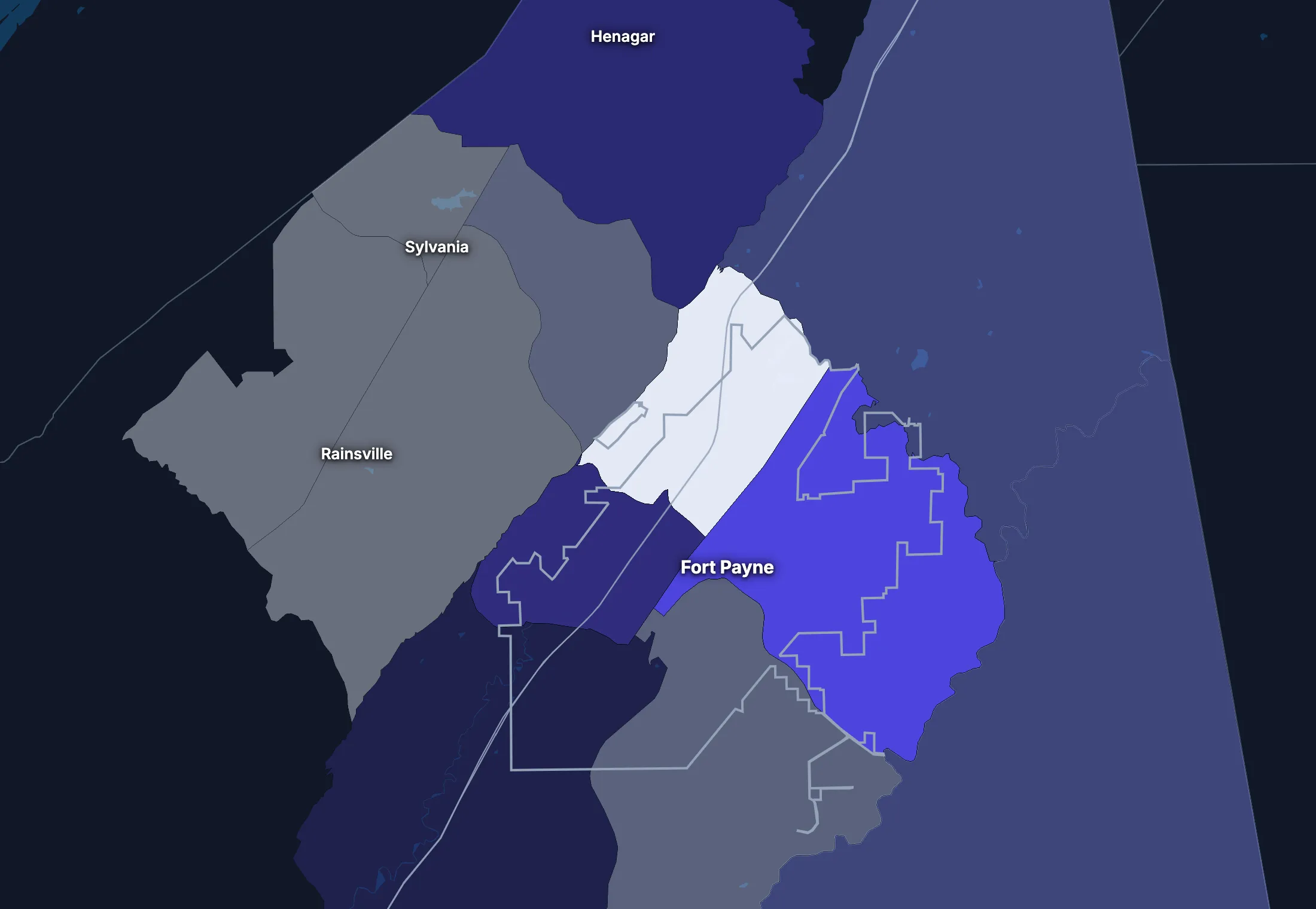
Where the city’s average misleads
Each tick is one census tract, and the dark line marks the city. Hover over a tick or tap it to see the tract.
Poverty
0 of 3 tracts are at least 1.5 times the city’s overall 31.9%, and 1 is at two-thirds of it or less.
Lowest: Tract 9612, 16.1%.
Adults with a bachelor’s degree
1 of 3 tracts is at least 1.5 times the city’s overall 18.4%, and 1 is at two-thirds of it or less.
Highest: Tract 9612, 37.4%. Lowest: Tract 9613, 9.1%.
Median household income
1 of 3 tracts is at least 1.5 times the typical tract’s $40,721, and 0 are at two-thirds of it or less.
Highest: Tract 9612, $70,750.
American Community Survey 2020–2024 5-year estimates, by census tract. Income is capped at $250,000+ by the Census Bureau.
People
Who lives in Fort Payne
Its median age of 37.4 is about the same as both Alabama (39.3) and the US (38.9). 9.3% of residents were born outside the US, and 21.5% speak a language other than English at home.
Age
Source: ACS 2020–2024 5-year, table A01001.
Show data
| Fort Payne | Alabama | United States | |
|---|---|---|---|
| Under 18 | 26.3% ±3.9% , number 3,933 ±587 | 22.2% ±0.1% , number 1,130,725 ±5,708 | 22.0% ±<0.1% , number 73,517,834 ±38,890 |
| 18 to 24 | 10.3% ±2.5% , number 1,538 ±375 | 9.5% ±0.1% , number 482,337 ±4,669 | 9.1% ±<0.1% , number 30,597,362 ±37,780 |
| 25 to 34 | 10.2% ±1.8% , number 1,530 ±270 | 12.9% ±<0.1% , number 655,463 ±1,426 | 13.7% ±<0.1% , number 45,806,540 ±10,200 |
| 35 to 44 | 12.9% ±2.1% , number 1,923 ±311 | 12.4% ±0.1% , number 632,006 ±4,825 | 13.2% ±<0.1% , number 44,237,292 ±43,510 |
| 45 to 54 | 12.1% ±2.6% , number 1,799 ±393 | 12.2% ±<0.1% , number 618,872 ±1,209 | 12.2% ±<0.1% , number 40,743,799 ±8,564 |
| 55 to 64 | 12.7% ±2.5% , number 1,893 ±375 | 13.0% ±0.1% , number 663,106 ±5,269 | 12.7% ±<0.1% , number 42,386,044 ±41,500 |
| 65 to 74 | 8.4% ±1.5% , number 1,254 ±220 | 10.7% ±0.1% , number 542,349 ±4,730 | 10.2% ±<0.1% , number 34,092,907 ±38,800 |
| 75 and over | 7.1% ±1.6% , number 1,057 ±242 | 7.1% ±0.1% , number 361,910 ±3,673 | 7.0% ±<0.1% , number 23,540,721 ±31,560 |
Embed
Race and ethnicity
Source: ACS 2020–2024 5-year, table A04001.
Show data
| Fort Payne | Alabama | United States | |
|---|---|---|---|
| White, not Hispanic | 71.5% ±5.7% , number 10,670 ±855 | 63.4% ±<0.1% , number 3,224,860 ±2,242 | 57.4% ±<0.1% , number 192,214,378 ±30,950 |
| Hispanic or Latino | 23.7% ±5.9% , number 3,538 ±885 | 5.6% ±<0.1% , number 284,135 ±217 | 19.3% ±<0.1% , number 64,759,370 ±1,547 |
| Black, not Hispanic | 1.3% ±0.7% , number 194 ±106 | 25.6% ±0.1% , number 1,302,911 ±3,566 | 11.9% ±<0.1% , number 39,896,127 ±46,710 |
| Asian, not Hispanic | 0.2% ±0.2% , number 28 ±28 | 1.4% ±<0.1% , number 73,353 ±1,346 | 5.9% ±<0.1% , number 19,678,814 ±22,770 |
| Other or multiracial | 3.3% ±1.1% , number 497 ±164 | 4.0% ±0.1% , number 201,509 ±4,301 | 5.5% ±<0.1% , number 18,373,810 ±69,180 |
Embed
Language spoken at home
Source: ACS 2020–2024 5-year, table C16001.
Show data
| Fort Payne | Alabama | United States | |
|---|---|---|---|
| English only | 78.5% ±5.7% , number 10,820 ±826 | 94.0% ±0.1% , number 4,503,218 ±5,359 | 77.7% ±0.1% , number 245,767,039 ±221,000 |
| Spanish | 20.0% ±5.7% , number 2,757 ±788 | 3.9% ±0.1% , number 187,711 ±3,307 | 13.6% ±<0.1% , number 42,869,908 ±143,800 |
| Other Indo-European | 1.0% ±0.9% , number 136 ±121 | 0.8% ±<0.1% , number 39,894 ±2,215 | 3.9% ±<0.1% , number 12,249,474 ±54,760 |
| Asian and Pacific Island | 0.1% ±0.3% , number 7 ±45 | 0.9% ±<0.1% , number 44,543 ±2,277 | 3.6% ±<0.1% , number 11,320,253 ±40,030 |
| Arabic and other | 0.5% ±0.7% , number 66 ±98 | 0.4% ±<0.1% , number 17,664 ±2,204 | 1.2% ±<0.1% , number 3,935,874 ±33,550 |
Embed
Marital status
Source: ACS 2020–2024 5-year, table A11001.
Show data
| Fort Payne | Alabama | United States | |
|---|---|---|---|
| Now married | 44.3% ±3.6% , number 5,191 ±460 | 47.3% ±0.2% , number 1,967,729 ±9,305 | 47.8% ±0.1% , number 131,199,078 ±272,700 |
| Never married | 29.2% ±3.8% , number 3,422 ±461 | 31.9% ±0.2% , number 1,325,550 ±7,458 | 34.4% ±0.1% , number 94,480,845 ±211,900 |
| Divorced | 16.4% ±3.5% , number 1,925 ±414 | 12.0% ±0.1% , number 498,195 ±5,595 | 10.6% ±<0.1% , number 29,074,059 ±73,390 |
| Widowed | 7.0% ±2.0% , number 817 ±231 | 6.9% ±0.1% , number 288,332 ±3,732 | 5.6% ±<0.1% , number 15,250,943 ±26,710 |
| Separated | 3.1% ±1.3% , number 361 ±153 | 1.8% ±0.1% , number 76,741 ±2,550 | 1.7% ±<0.1% , number 4,592,038 ±29,170 |
Embed
Where people lived a year ago
Source: ACS 2020–2024 5-year, table A08001.
Show data
| Fort Payne | Alabama | United States | |
|---|---|---|---|
| Same home | 92.5% ±3.1% , number 13,618 ±475 | 88.3% ±0.2% , number 4,441,777 ±8,749 | 87.7% ±0.1% , number 290,692,803 ±173,800 |
| Same county | 4.5% ±2.7% , number 667 ±402 | 6.1% ±0.2% , number 309,235 ±8,745 | 6.3% ±<0.1% , number 20,792,831 ±117,600 |
| Another county in the state | 1.8% ±1.0% , number 272 ±149 | 2.9% ±0.1% , number 145,249 ±4,462 | 3.1% ±<0.1% , number 10,316,864 ±51,200 |
| Another state | 1.1% ±0.8% , number 166 ±113 | 2.4% ±0.1% , number 119,534 ±4,216 | 2.3% ±<0.1% , number 7,577,400 ±40,570 |
| Another country | 0.0% ±0.1% , number 0 ±21 | 0.3% ±<0.1% , number 17,184 ±2,164 | 0.6% ±<0.1% , number 2,060,087 ±23,560 |
Embed
Top countries of birth, among those born abroad
Source: ACS 2020–2024 5-year, table A07001.
Show data
| Fort Payne | |
|---|---|
| Guatemala | 45.4% , number 633 |
| Mexico | 32.9% , number 459 |
| Romania | 4.9% , number 68 |
| Germany | 3.2% , number 45 |
| India | 3.2% , number 45 |
| Colombia | 1.9% , number 27 |
Embed
All the numbers
| Indicator | Fort Payne | Alabama | US | Rank in Alabama* | Table |
|---|---|---|---|---|---|
| Population | 14,927 ±43 | 5,086,768 | 334,922,499 | 49th | A00001 |
| People per square mile | 265 ±1 | 100 | 95 | 225th | A00002 |
| Land area (square miles) | 56 | – | – | – | A00002 |
| Median age | 37.4 ±3.1 | 39.3 ±0.2 | 38.9 ±0.1 | 210th | A01004 |
| Under 18 | 26.3% ±3.9% , number 3,933 ±587 | 22.2% ±0.1% , number 1,130,725 ±5,708 | 22.0% ±<0.1% , number 73,517,834 ±38,890 | 76th | B02002 |
| 65 and over | 15.5% ±2.2% , number 2,311 ±327 | 17.8% ±0.1% , number 904,259 ±5,988 | 17.2% ±<0.1% , number 57,633,628 ±50,010 | 226th | B02002 |
| Born outside the US | 9.3% ±2.6% , number 1,394 ±392 | 4.0% ±0.1% , number 203,578 ±4,382 | 14.1% ±<0.1% , number 47,349,078 ±143,600 | 18th | A06001 |
| Speak a language other than English at home | 21.5% ±5.7% , number 2,966 ±805 | 6.0% ±0.1% , number 289,812 ±5,088 | 22.3% ±0.1% , number 70,375,509 ±162,500 | 10th | C16001 |
| Veterans (adults) | 5.7% ±1.9% , number 628 ±206 | 7.7% ±0.1% , number 303,253 ±4,702 | 6.2% ±<0.1% , number 16,185,883 ±45,250 | 221st | A16002 |
| Living with a disability | 15.5% ±2.5% , number 2,257 ±368 | 16.5% ±0.1% , number 824,128 ±6,739 | 13.3% ±<0.1% , number 43,869,797 ±68,920 | 213th | B18101 |
| Women 15–50 who had a baby in the past year | 3.1%† (too uncertain to lean on) ±2.4% , number 114 ±89 | 5.0% ±0.2% , number 59,417 ±2,024 | 5.1% ±<0.1% , number 4,009,203 ±20,900 | 215th | B13002 |
| Lived in the same home a year ago | 92.5% ±3.1% , number 13,618 ±475 | 88.3% ±0.2% , number 4,441,777 ±8,749 | 87.7% ±0.1% , number 290,692,803 ±173,800 | 116th | A08001 |
| White, not Hispanic | 71.5% ±5.7% , number 10,670 ±855 | 63.4% ±<0.1% , number 3,224,860 ±2,242 | 57.4% ±<0.1% , number 192,214,378 ±30,950 | 161st | A04001 |
| Hispanic or Latino | 23.7% ±5.9% , number 3,538 ±885 | 5.6% ±<0.1% , number 284,135 ±217 | 19.3% ±<0.1% , number 64,759,370 ±1,547 | 10th | A04001 |
| Black, not Hispanic | 1.3% ±0.7% , number 194 ±106 | 25.6% ±0.1% , number 1,302,911 ±3,566 | 11.9% ±<0.1% , number 39,896,127 ±46,710 | 279th | A04001 |
| Asian, not Hispanic | 0.2%† (too uncertain to lean on) ±0.2% , number 28 ±28 | 1.4% ±<0.1% , number 73,353 ±1,346 | 5.9% ±<0.1% , number 19,678,814 ±22,770 | 162nd | A04001 |
*1 is the highest. Population is ranked among all places, and the rest among those of 1,000 people or more, whose figures can be ranked. Ranks use 5-year estimates, the only ones covering every city, so they can differ slightly from the figures here.
Income and work
Lower incomes and a wide coverage gap
The median household income is $47,479, lower than both Alabama ($63,999) and the US ($80,734). 32.5% of people live in poverty, and 16.3% have no health insurance, higher than both Alabama (9.2%) and the US (8.4%).
Household income
Source: ACS 2020–2024 5-year, table A14001.
Show data
| Fort Payne | Alabama | United States | |
|---|---|---|---|
| Under $25,000 | 25.8% ±5.7% , number 1,425 ±332 | 19.7% ±0.3% , number 394,075 ±5,228 | 14.6% ±<0.1% , number 18,908,588 ±41,540 |
| $25,000 to $49,999 | 25.7% ±5.2% , number 1,421 ±305 | 20.3% ±0.3% , number 404,774 ±5,348 | 16.7% ±<0.1% , number 21,624,902 ±39,130 |
| $50,000 to $74,999 | 20.0% ±4.9% , number 1,103 ±279 | 16.7% ±0.2% , number 332,863 ±4,932 | 15.5% ±<0.1% , number 20,031,683 ±36,850 |
| $75,000 to $99,999 | 10.1% ±2.2% , number 558 ±126 | 12.7% ±0.2% , number 253,461 ±3,921 | 12.6% ±<0.1% , number 16,319,799 ±42,700 |
| $100,000 to $149,999 | 11.3% ±3.3% , number 626 ±187 | 15.5% ±0.2% , number 310,078 ±5,030 | 17.5% ±<0.1% , number 22,670,921 ±58,280 |
| $150,000 to $199,999 | 5.1% ±1.8% , number 281 ±103 | 7.4% ±0.2% , number 147,127 ±3,096 | 9.6% ±<0.1% , number 12,405,370 ±57,560 |
| $200,000 or more | 2.0% ±1.2% , number 108 ±67 | 7.8% ±0.1% , number 154,869 ±2,657 | 13.4% ±0.1% , number 17,266,233 ±82,370 |
Embed
What residents do for work
Source: ACS 2020–2024 5-year, table A17004.
Show data
| Fort Payne | Alabama | United States | |
|---|---|---|---|
| Manufacturing | 20.6% ±3.8% , number 1,273 ±257 | 14.1% ±0.2% , number 317,853 ±4,530 | 9.9% ±<0.1% , number 15,940,000 ±38,890 |
| Education and health care | 19.6% ±4.0% , number 1,208 ±268 | 22.7% ±0.3% , number 511,346 ±6,419 | 23.5% ±0.1% , number 37,913,663 ±133,200 |
| Other services | 10.9% ±4.6% , number 675 ±289 | 4.8% ±0.1% , number 108,269 ±3,065 | 4.7% ±<0.1% , number 7,588,496 ±24,900 |
| Retail trade | 9.1% ±3.4% , number 558 ±213 | 11.6% ±0.2% , number 261,448 ±4,590 | 10.8% ±<0.1% , number 17,456,908 ±41,100 |
| Professional and business services | 8.4% ±2.9% , number 516 ±185 | 10.1% ±0.2% , number 227,311 ±3,791 | 12.6% ±<0.1% , number 20,282,450 ±59,650 |
| Arts, food and lodging | 7.6% ±2.9% , number 470 ±185 | 8.1% ±0.2% , number 181,837 ±3,952 | 8.7% ±<0.1% , number 13,952,453 ±52,980 |
| Construction | 5.2% ±2.9% , number 323 ±183 | 7.0% ±0.2% , number 157,222 ±3,650 | 6.9% ±<0.1% , number 11,167,040 ±57,000 |
| Transportation and warehousing | 5.0% ±2.9% , number 311 ±183 | 5.9% ±0.1% , number 133,434 ±3,025 | 5.9% ±<0.1% , number 9,568,767 ±29,300 |
Embed
Where workers come from and go
Fort Payne has 13,122 jobs and 6,089 employed residents. 9,991 people commute in to work and 2,958 commute out, while 3,131 both live and work here. The most commuters come from Rainsville city.
Most commuters come from
- Rainsville city: 690
- Henagar city: 257
- Huntsville city: 181
Most residents commute to
- Rainsville city: 299
- Huntsville city: 217
- Chattanooga city: 154
Show data
| Fort Payne | |
|---|---|
| Live and work here | 3,131 |
| Work here, live elsewhere | 9,991 |
| Live here, work elsewhere | 2,958 |
Embed
All the numbers
| Indicator | Fort Payne | Alabama | US | Rank in Alabama* | Table |
|---|---|---|---|---|---|
| Median household income | $47,479 ±$7,304 | $63,999 ±$399 | $80,734 ±$166 | 220th | A14006 |
| Income per person | $26,126 ±$2,831 | $36,087 ±$217 | $44,673 ±$122 | 220th | A14024 |
| Income inequality (Gini index) | 0.482 ±0.048 | 0.479 ±0.003 | 0.483 | 74th | A14028 |
| Living in poverty | 32.5% ±5.9% , number 4,706 ±855 | 15.6% ±0.2% , number 772,360 ±9,870 | 12.5% ±0.1% , number 40,735,661 ±275,900 | 30th | A13004 |
| Unemployment rate | 5.0% ±3.2% , number 323 ±207 | 4.7% ±0.1% , number 111,265 ±3,023 | 5.2% ±<0.1% , number 8,902,365 ±38,980 | 139th | A17005 |
| No health insurance | 16.3% ±3.5% , number 2,376 ±505 | 9.2% ±0.1% , number 459,841 ±7,402 | 8.4% ±<0.1% , number 27,734,911 ±158,900 | 28th | A20001 |
*1 is the highest. Population is ranked among all places, and the rest among those of 1,000 people or more, whose figures can be ranked. Ranks use 5-year estimates, the only ones covering every city, so they can differ slightly from the figures here.
Education
Fewer college degrees than the US
17.3% of adults 25 and over have a bachelor’s degree or more, lower than both Alabama (28.4%) and the US (35.7%).
Highest level of education
Source: ACS 2020–2024 5-year, table A12001.
Show data
| Fort Payne | Alabama | United States | |
|---|---|---|---|
| Less than high school | 20.8% ±4.6% , number 1,964 ±445 | 11.4% ±0.2% , number 395,315 ±5,914 | 10.4% ±<0.1% , number 23,992,410 ±82,490 |
| High school only | 28.9% ±4.0% , number 2,730 ±399 | 30.3% ±0.3% , number 1,052,769 ±9,245 | 26.0% ±0.1% , number 60,094,716 ±262,500 |
| Some college | 33.1% ±4.9% , number 3,128 ±483 | 29.9% ±0.2% , number 1,040,139 ±8,608 | 27.9% ±0.1% , number 64,356,961 ±143,900 |
| Bachelor’s degree | 9.0% ±2.1% , number 853 ±202 | 17.3% ±0.2% , number 600,262 ±7,145 | 21.6% ±0.1% , number 49,868,171 ±191,400 |
| Graduate degree | 8.3% ±2.3% , number 781 ±218 | 11.1% ±0.2% , number 385,221 ±5,271 | 14.1% ±0.1% , number 32,495,045 ±159,600 |
Embed
All the numbers
| Indicator | Fort Payne | Alabama | US | Rank in Alabama* | Table |
|---|---|---|---|---|---|
| Bachelor’s degree or more | 17.3% ±3.0% , number 1,634 ±298 | 28.4% ±0.3% , number 985,483 ±8,879 | 35.7% ±0.1% , number 82,363,216 ±249,200 | 178th | A12001 |
| High school graduate or more | 79.2% ±6.3% , number 7,492 ±693 | 88.6% ±0.4% , number 3,078,391 ±15,440 | 89.6% ±0.2% , number 206,814,893 ±389,500 | 276th | A12001 |
*1 is the highest. Population is ranked among all places, and the rest among those of 1,000 people or more, whose figures can be ranked. Ranks use 5-year estimates, the only ones covering every city, so they can differ slightly from the figures here.
Housing
Home values outran incomes
30.7% of households rent, about the same as Alabama (29.8%) but not statistically different from the US (34.8%). The median home is worth $157,000 and the median rent is $679. After inflation, home values rose 22% from 2010–2014 to 2020–2024, while household income rose 3%.
Housing costs and income, 2010–2014 to 2020–2024, after inflation
Source: ACS 5-year, table A10036, A18009, A14006.
Show data
| Fort Payne | Alabama | United States | |
|---|---|---|---|
| Median home value | +22.1% | +27.7% | +42.6% |
| Median rent | −4.2% | +6.1% | +15.6% |
| Median household income | +3.1% | +10.8% | +13.7% |
Embed
Types of homes
Source: ACS 2020–2024 5-year, table A10032.
Show data
| Fort Payne | Alabama | United States | |
|---|---|---|---|
| Single-family, detached | 74.5% ±4.7% , number 4,745 ±414 | 69.1% ±0.2% , number 1,615,503 ±5,711 | 61.3% ±0.1% , number 88,075,458 ±149,800 |
| Single-family, attached | 0.7% ±0.7% , number 46 ±42 | 1.9% ±0.1% , number 44,189 ±1,627 | 6.2% ±<0.1% , number 8,955,086 ±33,580 |
| 2 to 4 units | 7.3% ±3.1% , number 468 ±197 | 4.8% ±0.1% , number 111,379 ±3,098 | 7.7% ±<0.1% , number 11,031,346 ±42,810 |
| 5 to 19 units | 7.0% ±2.8% , number 443 ±178 | 7.3% ±0.2% , number 171,627 ±3,924 | 8.8% ±<0.1% , number 12,625,154 ±51,990 |
| 20 or more units | 1.8% ±1.4% , number 114 ±87 | 4.4% ±0.1% , number 102,137 ±2,930 | 10.3% ±<0.1% , number 14,859,547 ±31,000 |
| Mobile homes and other | 8.7% ±3.4% , number 553 ±216 | 12.5% ±0.2% , number 292,430 ±4,050 | 5.7% ±<0.1% , number 8,228,764 ±48,580 |
Embed
When homes were built
Source: ACS 2020–2024 5-year, table A10055.
Show data
| Fort Payne | Alabama | United States | |
|---|---|---|---|
| 2010 or later | 5.1% ±2.3% , number 281 ±126 | 13.8% ±0.2% , number 275,246 ±4,405 | 11.6% ±<0.1% , number 14,996,534 ±51,640 |
| 2000 to 2009 | 11.5% ±4.1% , number 637 ±231 | 15.9% ±0.2% , number 318,478 ±5,000 | 13.8% ±<0.1% , number 17,865,859 ±70,250 |
| 1980 to 1999 | 29.7% ±5.3% , number 1,641 ±312 | 29.5% ±0.3% , number 589,549 ±6,342 | 25.3% ±<0.1% , number 32,758,140 ±75,080 |
| 1960 to 1979 | 32.9% ±6.7% , number 1,814 ±389 | 25.8% ±0.3% , number 516,015 ±6,009 | 23.9% ±<0.1% , number 30,938,809 ±78,560 |
| Before 1960 | 20.8% ±5.0% , number 1,149 ±286 | 14.9% ±0.2% , number 297,959 ±4,664 | 25.3% ±<0.1% , number 32,668,154 ±83,060 |
Embed
All the numbers
| Indicator | Fort Payne | Alabama | US | Rank in Alabama* | Table |
|---|---|---|---|---|---|
| Housing units | 6,369 ±385 | – | – | – | A10001 |
| Households | 5,522 ±380 | – | – | – | A10008 |
| People per household | 2.64 ±0.18 | 2.48 ±0.01 | 2.53 ±0.01 | 112th | A10003 |
| Households that rent | 30.7% ±5.8% , number 1,695 ±343 | 29.8% ±0.3% , number 595,092 ±6,593 | 34.8% ±0.1% , number 45,017,354 ±163,600 | 151st | A10060 |
| Vacant homes | 13.3% ±3.8% , number 847 ±248 | 14.5% ±0.3% , number 340,018 ±6,268 | 10.1% ±0.1% , number 14,547,859 ±200,400 | 148th | A10047, A10060 |
| Median gross rent | $679 ±$37 | $1,007 ±$8 | $1,413 ±$2 | 235th | A18009 |
| Median home value | $157,000 ±$17,970 | $209,900 ±$1,076 | $332,700 ±$236 | 179th | A10036 |
| Renters paying 30% or more of income | 34.5% ±10.5% , number 584 ±214 | 42.5% ±0.5% , number 253,158 ±4,214 | 47.6% ±0.2% , number 21,422,415 ±63,960 | 200th | A18002 |
| Owners paying 30% or more of income | 19.6% ±6.4% , number 750 ±255 | 17.7% ±0.3% , number 248,409 ±4,111 | 22.5% ±0.1% , number 18,961,895 ±39,930 | 118th | A10040 |
| Homes built before 1960 | 20.8% ±5.0% , number 1,149 ±286 | 14.9% ±0.2% , number 297,959 ±4,664 | 25.3% ±<0.1% , number 32,668,154 ±83,060 | 108th | A10055 |
*1 is the highest. Population is ranked among all places, and the rest among those of 1,000 people or more, whose figures can be ranked. Ranks use 5-year estimates, the only ones covering every city, so they can differ slightly from the figures here.
Getting around
A driving city with short commutes
78.3% of workers drive alone and 7.2% work from home. 17.8% of those who travel to work spend 30 minutes or more getting there, and 5.1% of households have no vehicle.
How people get to work
Source: ACS 2020–2024 5-year, table A09005.
Show data
| Fort Payne | Alabama | United States | |
|---|---|---|---|
| Drive alone | 78.3% ±4.0% , number 4,818 ±465 | 80.6% ±0.3% , number 1,796,123 ±8,868 | 68.8% ±0.1% , number 109,447,738 ±95,800 |
| Carpool | 12.2% ±3.5% , number 751 ±223 | 8.0% ±0.2% , number 178,991 ±3,877 | 8.5% ±<0.1% , number 13,569,614 ±52,500 |
| Public transit | 0.0% ±0.5% , number 0 ±30 | 0.4% ±<0.1% , number 8,467 ±968 | 3.5% ±<0.1% , number 5,573,279 ±22,170 |
| Walk | 1.4% ±1.3% , number 86 ±81 | 1.1% ±0.1% , number 25,583 ±1,393 | 2.4% ±<0.1% , number 3,772,609 ±17,080 |
| Work from home | 7.2% ±2.7% , number 443 ±172 | 8.8% ±0.2% , number 196,829 ±4,506 | 15.1% ±<0.1% , number 24,042,489 ±82,860 |
| Other | 0.9% ±1.2% , number 56 ±77 | 1.0% ±0.1% , number 23,086 ±1,456 | 1.7% ±<0.1% , number 2,708,365 ±17,940 |
Embed
Time spent getting to work
Source: ACS 2020–2024 5-year, table B09001.
Show data
| Fort Payne | Alabama | United States | |
|---|---|---|---|
| Under 10 minutes | 24.6% ±5.3% , number 1,404 ±328 | 12.1% ±0.2% , number 246,091 ±4,198 | 12.7% ±<0.1% , number 17,153,542 ±40,730 |
| 10 to 19 minutes | 46.2% ±7.1% , number 2,639 ±466 | 29.6% ±0.3% , number 601,934 ±6,713 | 28.7% ±<0.1% , number 38,741,521 ±54,980 |
| 20 to 29 minutes | 11.4% ±4.3% , number 652 ±250 | 22.7% ±0.3% , number 460,924 ±5,928 | 21.3% ±<0.1% , number 28,723,420 ±52,330 |
| 30 to 39 minutes | 4.7% ±1.7% , number 266 ±102 | 17.6% ±0.3% , number 357,088 ±5,884 | 16.9% ±<0.1% , number 22,853,044 ±46,230 |
| 40 to 59 minutes | 11.2% ±4.1% , number 638 ±238 | 11.1% ±0.2% , number 225,071 ±4,655 | 11.9% ±<0.1% , number 16,024,037 ±44,090 |
| 60 minutes or more | 2.0% ±1.1% , number 112 ±65 | 6.9% ±0.2% , number 141,142 ±3,503 | 8.6% ±<0.1% , number 11,576,041 ±36,550 |
Embed
Vehicles per household
Source: ACS 2020–2024 5-year, table A10030.
Show data
| Fort Payne | Alabama | United States | |
|---|---|---|---|
| None | 5.1% ±2.7% , number 283 ±152 | 5.4% ±0.2% , number 107,590 ±3,024 | 8.4% ±<0.1% , number 10,793,323 ±36,450 |
| One | 35.1% ±6.6% , number 1,937 ±389 | 31.6% ±0.3% , number 630,767 ±7,057 | 33.1% ±0.1% , number 42,801,892 ±122,600 |
| Two | 39.2% ±6.1% , number 2,163 ±367 | 36.6% ±0.4% , number 731,666 ±7,529 | 36.6% ±0.1% , number 47,334,152 ±191,100 |
| Three or more | 20.6% ±3.9% , number 1,139 ±232 | 26.4% ±0.3% , number 527,224 ±5,703 | 21.9% ±0.1% , number 28,298,129 ±85,940 |
Embed
All the numbers
| Indicator | Fort Payne | Alabama | US | Rank in Alabama* | Table |
|---|---|---|---|---|---|
| Drive to work alone | 78.3% ±4.0% , number 4,818 ±465 | 80.6% ±0.3% , number 1,796,123 ±8,868 | 68.8% ±0.1% , number 109,447,738 ±95,800 | 247th | A09005 |
| Take public transit | 0.0%† (too uncertain to lean on) ±0.5% , number 0 ±30 | 0.4% ±<0.1% , number 8,467 ±968 | 3.5% ±<0.1% , number 5,573,279 ±22,170 | 78th | A09005 |
| Work from home | 7.2% ±2.7% , number 443 ±172 | 8.8% ±0.2% , number 196,829 ±4,506 | 15.1% ±<0.1% , number 24,042,489 ±82,860 | 117th | A09005 |
| Commute 30 minutes or more | 17.8% ±4.4% , number 1,016 ±267 | 35.6% ±0.4% , number 723,301 ±8,281 | 37.4% ±<0.1% , number 50,453,122 ±73,600 | 309th | B09001 |
| Households with no vehicle | 5.1% ±2.5% , number 283 ±142 | 5.4% ±0.2% , number 107,590 ±3,065 | 8.4% ±<0.1% , number 10,793,323 ±27,220 | 154th | A10030 |
*1 is the highest. Population is ranked among all places, and the rest among those of 1,000 people or more, whose figures can be ranked. Ranks use 5-year estimates, the only ones covering every city, so they can differ slightly from the figures here.
Places
In and around Fort Payne
Population, from the latest estimates available. Figures cover the whole of each place.
Places nearby
- Scottsboro: 15,712
- Rainsville: 5,702
- Centre: 3,700
- Henagar: 2,501
- Crossville: 2,143
- Sylvania: 1,925
- Collinsville: 1,781
- Cedar Bluff: 1,629
Its county
- DeKalb County: 74,085
Places like this one
- Muscatine, Iowa: 23,489
- Clifton, Colorado: 19,518
- Bonham, Texas: 10,697
- Berryville, Arkansas: 5,707
Places at least a third this size, with the closest income, education, age, housing and origins.
Turn Fort Payne into your planning report.
Social Explorer Studio builds an editable profile of any place, with tables and charts beside the county and state, and exports to Word, PDF and Excel.
Questions about Fort Payne
What is the population of Fort Payne, Alabama?
14,927 people (±43), according to the ACS 2020–2024 5-year estimates. That’s the 49th largest of 592 places in Alabama.
What is the FIPS code for Fort Payne, Alabama?
0127616. The first two digits, 01, are Alabama’s state code, and the last five, 27616, identify Fort Payne within it. The Census Bureau’s full geographic identifier (GEOID) is 1600000US0127616.
What county is Fort Payne in?
Fort Payne is in DeKalb County.
What is the median household income in Fort Payne?
$47,479 (±$7,304), according to the ACS 2020–2024 5-year estimates, lower than both Alabama ($63,999) and the US ($80,734).
What is the median age in Fort Payne?
37.4 years (±3.1), according to the ACS 2020–2024 5-year estimates, about the same as both Alabama (39.3) and the US (38.9).
How much does housing cost in Fort Payne?
Fort Payne’s median home value is $157,000 (±$17,970) and its median gross rent is $679 (±$37) a month, according to the ACS 2020–2024 5-year estimates. 34.5% (±10.5%) of its renters pay 30% or more of their income on rent.
Is Fort Payne growing?
Fort Payne’s population grew 5.8%, from 14,115 in 2010–2014 to 14,927 in 2020–2024, according to the ACS 5-year estimates.
Where do people who work in Fort Payne live?
3,131 of its 13,122 jobs are held by people who live here. Of those who commute in, the most come from Rainsville city, Henagar city, Huntsville city.
Where does this census data come from?
The U.S. Census Bureau’s American Community Survey, through Social Explorer’s tables: the latest 1-year estimates where they exist, for the most recent numbers, and 5-year estimates otherwise. Each table lists its code, so you can find it again.
Is this data free to use?
Yes. You can read it, cite it, download the CSV and embed the charts, with no account. To map other variables, compare your own areas or build a report, see Social Explorer’s plans in a live demo.
Sources and how to cite
American Community Survey 2020–2024 5-year estimates, U.S. Census Bureau, from Social Explorer’s tables A00001, A00002, A01004, A04001, A06001, A08001, A09005, A10001, A10003, A10008, A10030, A10036, A10040, A10047, A10055, A10060, A12001, A13004, A14006, A14024, A14028, A16002, A17005, A18002, A18009, A20001, B02002, B09001, B13002, B18101, C16001. Maps by census tract use 2020–2024 5-year estimates, since the 1-year survey doesn’t cover tracts. Commuting: LEHD LODES 2023. These are estimates from a sample, each with its margin of error. Data retrieved November 14, 2026. How these profiles are made.
U.S. Census Bureau, American Community Survey 2020–2024 5-year estimates, via Social Explorer. “Fort Payne, Alabama.” https://www.socialexplorer.com/places/alabama/fort-payne-city. Accessed November 14, 2026.